


NetSuite strategic guidance is the process of aligning your ERP system with your long-term business goals to maximize ROI, operational efficiency, and competitive advantage. It goes far beyond implementation—it’s about changing NetSuite from a tool you use into a strategic asset that drives growth.
Here’s what effective NetSuite strategic guidance includes:
- Business alignment: Connecting NetSuite capabilities to your specific strategic objectives
- Implementation planning: Choosing the right approach (partner-led, direct, or in-house) for your business
- Optimization roadmap: Continuously improving processes, adoption, and system performance
- Change management: Ensuring teams accept new workflows and leverage NetSuite’s full potential
- Ongoing support: Proactive monitoring, feature adoption, and strategic advisement post-go-live
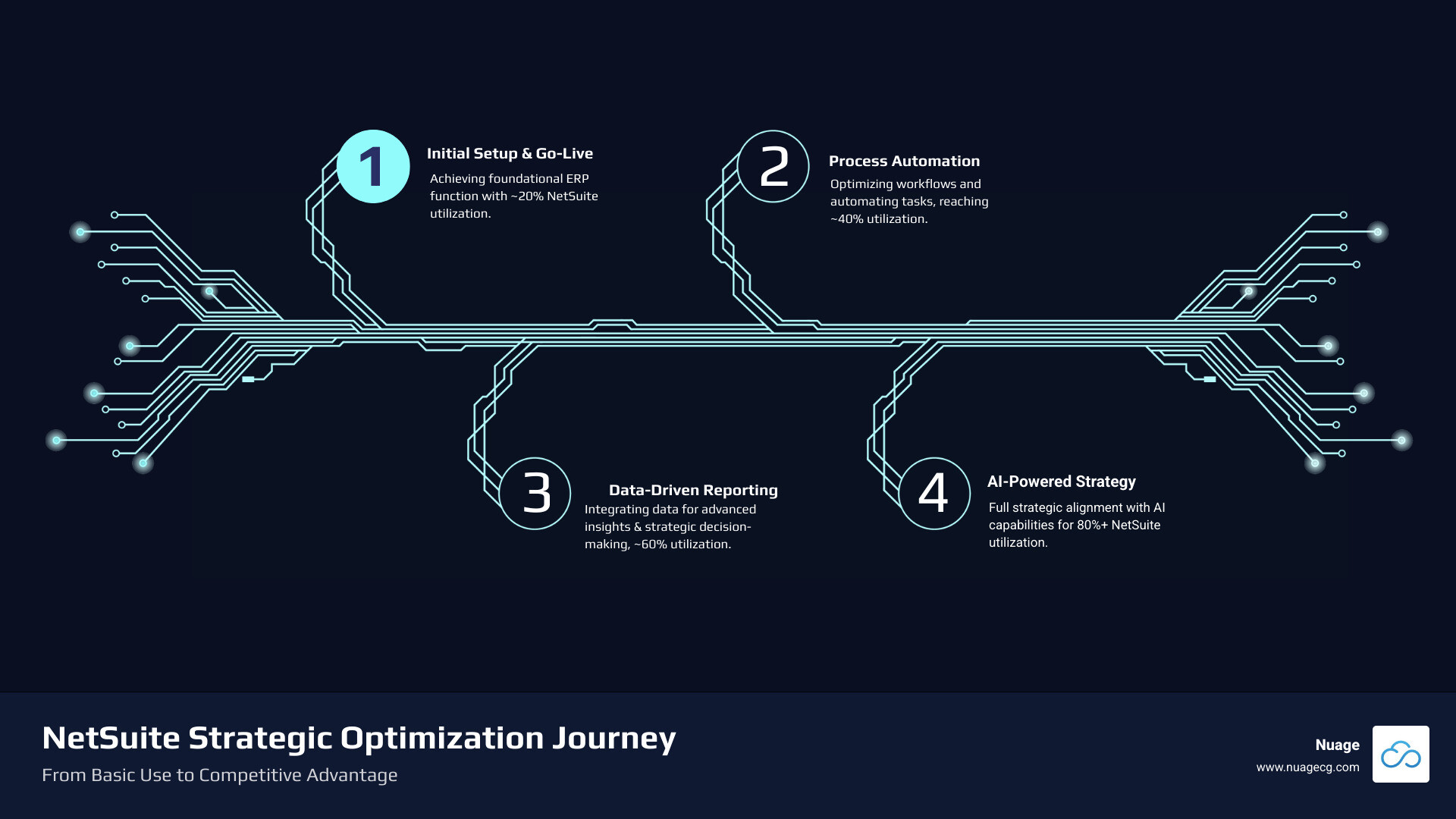
Most businesses only use about 20% of NetSuite’s capabilities. The gap between basic implementation and strategic optimization is what separates companies that merely have NetSuite from those that truly leverage it for competitive advantage.
The research is clear: 45% of companies using ERP systems underuse licensed modules, according to a 2023 Panorama Consulting survey. This isn’t just about wasted features—it’s about missed opportunities for automation, insight, and growth. These missed opportunities manifest in tangible ways: finance teams spending weeks on manual month-end closes instead of strategic analysis, sales reps lacking a unified view of customer history, and supply chain managers struggling with inaccurate inventory data. Without a strategic roadmap, NetSuite can become a glorified accounting system rather than the central nervous system of the business. Strategic guidance helps you close that gap by ensuring every dollar invested in NetSuite translates into measurable business value.
Whether you’re considering NetSuite for the first time, struggling with a stalled implementation, or looking to optimize an existing system, the right strategic approach makes all the difference. It’s about moving from reactive problem-solving to proactive innovation—from basic financial management to enterprise-wide digital change.
I’m Louis Balla, CRO and partner at Nuage, where I specialize in NetSuite strategic guidance and helping businesses bridge the NetSuite divide. Over 15 years in digital change and supply chain optimization have shown me that the companies who treat NetSuite as a strategic partner—not just software—are the ones who consistently outperform their competition. Our mission is to transform your NetSuite environment from a cost center into a value-driving engine.
Essential NetSuite strategic guidance terms:
The Strategic Foundation: Aligning NetSuite with Your Business Vision

Imagine setting sail without a compass. That’s what implementing NetSuite without a clear strategic vision feels like. Strategic planning is the systematic process through which organizations define their goals and develop the necessary procedures and operations to achieve that future. It anchors an organization by establishing a clear vision and a course for long-term success, helping us steer market twists and turns, evolving customer needs, and internal changes.
We believe that strategic planning isn’t a one-size-fits-all process; it must be custom to your unique circumstances, goals, and industry dynamics. Tools like SWOT analysis (Strengths, Weaknesses, Opportunities, Threats) and PESTEL analysis (Political, Economic, Social, Technological, Environmental, Legal) help us understand your internal landscape and external factors. This allows us to set SMART goals (Specific, Measurable, Achievable, Relevant, and Time-bound), forecast industry trends, and allocate resources to areas with the highest growth potential. Our goal is to ensure your NetSuite ERP implementation promotes long-term business viability by focusing on sustainable achievements, fostering a culture of continuous improvement and innovation.
For businesses aiming for significant growth, NetSuite is more than just software; it’s a platform for enterprise-level change. Our NetSuite for Enterprises Ultimate Guide digs deeper into how larger organizations can harness NetSuite’s full power.
When Should a Business Consider NetSuite?
The decision to implement NetSuite isn’t just about needing new software; it’s often a response to significant business challenges and growth opportunities. You should consider NetSuite when:
- Scaling Operations: Your current systems buckle under pressure. You experience slow performance during peak sales periods, and adding new product lines or business units requires complex, manual workarounds that aren’t sustainable.
- Complex Business Processes: Manual workflows are creating bottlenecks. For example, purchase orders require physical signatures, or revenue recognition for subscriptions is managed in complex spreadsheets, leading to delays and compliance risks.
- Data Silos: Your teams operate on different versions of the truth. Sales uses a separate CRM, finance has its accounting package, and inventory is tracked on yet another system, making a simple report like quote-to-cash analysis a monumental effort.
- Lack of Visibility: You’re flying blind. You can’t get a real-time view of cash flow, inventory levels across locations, or sales pipeline performance without manually compiling data from multiple sources, by which time the information is already outdated.
- Global Expansion: You’re managing multiple legal entities with different currencies, tax laws, and compliance requirements. Consolidating financials takes weeks, and intercompany transactions are a source of constant reconciliation headaches.
- Manual Workflows: Your most valuable employees are bogged down in repetitive data entry and administrative tasks instead of focusing on strategic work that drives the business forward.
If these scenarios sound familiar, it might be time to explore how NetSuite can provide a unified platform to manage and automate your entire business. Our Why Choose NetSuite? page offers more insights into its core benefits.
How to Leverage NetSuite for Strategic Goals
NetSuite’s power lies in its ability to integrate various business functions into a single, cloud-based platform, offering a holistic view and control that can be directly leveraged for strategic goals.
- Process Automation: By automating routine tasks in finance, order management, and inventory, NetSuite frees up your team to focus on strategic initiatives. This goes beyond simple tasks; think of multi-level approval workflows for purchase orders, automated revenue recognition schedules compliant with ASC 606, and rule-based case routing in customer service.
- Data-Driven Decisions: NetSuite provides real-time data across all departments. Using tools like SuiteAnalytics Workbooks, we can create dynamic, role-based dashboards that track critical KPIs like Days Sales Outstanding (DSO), inventory turnover, and customer lifetime value. This changes raw data into actionable insights for better decision-making.
- Customer 360: NetSuite’s CRM capabilities offer a comprehensive view of your customers by unifying marketing, sales, and service data. This allows for highly personalized customer experiences, proactive service, and targeted marketing campaigns that increase cross-sell/upsell opportunities and improve customer loyalty.
- Supply Chain Optimization: With NetSuite, we can gain end-to-end visibility into your supply chain. This enables advanced demand planning, automated reorder points to prevent stockouts, and strategic sourcing to build resilient supplier relationships. NetSuite Sourcing Management, for instance, simplifies the creation of sourcing events, helping us identify and vet suppliers effectively to reduce costs and mitigate risk.
- Financial Management: Beyond basic accounting, NetSuite offers advanced financial management tools for multi-subsidiary consolidation, budgeting, and forecasting. This allows for sophisticated scenario planning and variance analysis, providing a clearer path to profitability and more confident financial stewardship.
- Leveraging AI Capabilities: NetSuite is rapidly integrating AI into its platform, with innovations like NetSuite Next. Features such as agentic workflows automate complex, multi-step tasks across the system. Conversational intelligence provides context-aware answers and insights, while tools like “Ask Oracle” streamline data entry and configuration. This means your NetSuite solution can proactively assist in tasks, optimize itself, and accelerate issue resolution, directly contributing to efficiency and growth. Explore more about NetSuite’s AI Capabilities and how they can boost your growth in our guide: 4 Ways NetSuite ERP Can Boost Your Company’s Growth.
Choosing Your Path: Implementation Approaches and Partners

Starting on a NetSuite implementation is a significant undertaking, and choosing the right approach is paramount to its success. We’ve seen businesses approach this journey in three primary ways: directly with NetSuite, through a certified NetSuite partner, or by attempting an in-house implementation. Each path has its own set of advantages and disadvantages, and understanding these can help us determine the best fit for your organization. For a deeper dive into finding the right support, check out our insights on NetSuite ERP Implementation Partners.
Comparing Implementation Approaches: Partner, Direct, and In-house
| Factor | Partner-led Implementation | Direct (NetSuite) Implementation | In-house Implementation |
|---|---|---|---|
| Expertise & Best Practices | High. Partners bring deep industry knowledge and experience from multiple implementations, offering custom best practices. | High. Deep product knowledge, but may follow a more standardized, less industry-specific methodology. | Variable. Depends entirely on the internal team’s prior NetSuite experience, which is often limited. |
| Customization & Flexibility | High. Partners excel at tailoring NetSuite to unique business processes and integrating third-party systems. | Moderate. Can provide customization, but may be less flexible or more costly for highly specific needs. | High, but risky. High potential for poor design choices that create long-term technical debt without external guidance. |
| Cost | Moderate to High. Often provides better long-term ROI due to efficiency and expertise, but initial investment can be higher than in-house. | High. Typically one of the more expensive options, with less room for negotiation on service rates. | Low (perceived). Avoids external service fees but has high hidden costs: team salaries, opportunity cost of distraction, and fixing mistakes. |
| Support & Relationship | High. Partners offer a dedicated team, personalized support, and a long-term strategic relationship post-go-live. | Formal. Support is structured and effective but can be less personal and more ticket-based. | Self-reliant. The team must solve its own problems, which can lead to significant delays and frustration. |
| Timeline & Resource Focus | Efficient. An experienced partner can often accelerate the timeline and keep the project on track, allowing your team to focus on their core jobs. | Structured. Follows a set methodology, which can be rigid. Your internal team will still need significant time commitment. | Slow and Distracting. Often takes much longer as the internal team learns on the job and juggles implementation with daily responsibilities. |
Key Considerations When Selecting a NetSuite Implementation Partner
Choosing a partner is one of the most critical decisions in your NetSuite journey. The right partner acts as a strategic guide, not just a technical resource. Here’s what to look for:
- Proven Track Record and Industry Specialization: Don’t settle for a generalist. Look for a partner with a portfolio of successful projects in your specific industry, whether it’s manufacturing, wholesale distribution, retail, or software. They should understand your unique challenges and speak your language. Ask for case studies and client references relevant to your business.
- Technical Expertise and Customization Capabilities: A great partner has deep technical knowledge, including certified developers proficient in SuiteScript for custom workflows and integrations. Evaluate their ability to handle complex data migration from your legacy systems and connect NetSuite with other critical applications in your tech stack.
- Cultural Fit and Communication Style: This is a long-term relationship. The partner’s team will work closely with yours for months or even years. Ensure their communication style, project management approach, and company values align with yours. A strong cultural fit fosters trust and collaboration, which are essential for navigating the challenges of an ERP project.
- Project Methodology: Ask potential partners to walk you through their implementation methodology. Do they use a clear, structured process like Agile or a phased rollout? They should be able to provide a sample project plan, define clear roles and responsibilities, and explain how they manage scope, budget, and timelines.
- Post-Go-Live Support and Strategic Guidance: The real work begins after go-live. A true strategic partner doesn’t disappear once the system is live. Inquire about their post-implementation support options, optimization services, and ongoing strategic guidance. The goal is a partner who will help you continuously improve and maximize your NetSuite investment over time, which is central to the Nuage philosophy.