

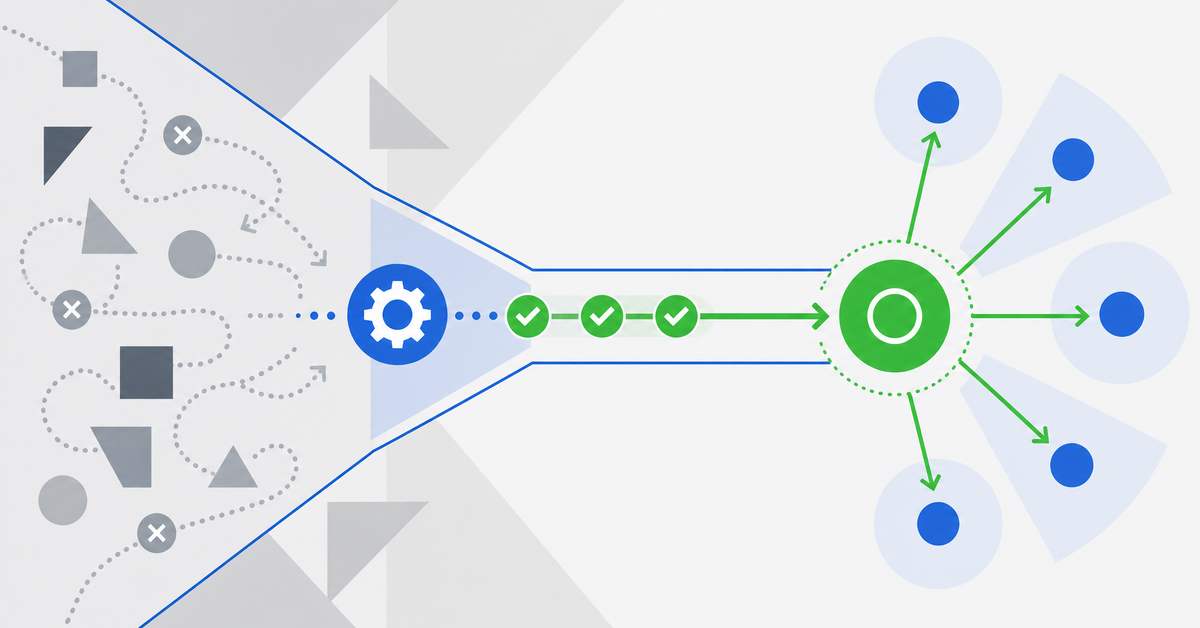
A mid-market manufacturer of scientific instruments and reagents ran its entire manufacturing automation workflow across two disconnected systems, with manual handoffs bleeding accuracy at every stage. The order-to-cash rebuild, still ahead of go-live, has standardized the full motion from quote through billing, corrected bill-of-materials data, and given the team a repeatable process they can actually trust.
When your sales order doesn’t carry the customer PO number through to the invoice, someone catches it during month-end close. Or they don’t. Either way, you’ve built a process that depends on one person remembering to copy a field from one system to another, and that’s not a process. That’s a workaround held together by institutional memory.
The Disconnect: Two Systems, No Clean Handoff
This manufacturer used HubSpot for its front-office sales motion and NetSuite for back-office operations. On paper, a reasonable setup. In practice, the two systems operated like separate companies.
Sales reps built quotes in HubSpot. When a deal closed, someone manually created a sales order in NetSuite. Customer PO numbers, requested delivery dates, and deal-specific notes existed in HubSpot but didn’t flow into NetSuite reliably. The invoice a customer received might reference the wrong PO number or omit the delivery date entirely.
Where the Breakdowns Actually Happened
Returns and cash sales had no documented procedure. Different team members handled them differently. One person might issue a credit memo. Another might create a standalone transaction. A third might email finance and hope for the best.
The result was a month-end close that consumed days of reconciliation. Finance couldn’t trust the numbers without manually cross-referencing HubSpot records against NetSuite transactions. Every exception became a mini-investigation.
This pattern is common across mid-market manufacturers. The 2025 Enterprise Automation Index reports that 48.6% of organizations report 25% or greater efficiency gains from automation, which highlights how much gets left behind when systems stay disconnected. The gap between what an ERP can do and what companies actually use it for explains most of these problems. Companies typically use only about 20% of their ERP’s capabilities, and a disconnected quote-to-cash flow is one of the clearest symptoms.
Manufacturing Automation Rebuild: From Quote to Invoice
Louis Balla, CRO at Nuage, led the rebuild approach. The team mapped the full order-to-cash flow before touching a single configuration. Every handoff point between HubSpot and NetSuite got documented. Every manual step, every spreadsheet workaround, every “we just know to do that” process.
Standardizing the System of Record
The first decision was structural. HubSpot became the system of record that triggers NetSuite. Not the other way around. Not both. One direction, one source of truth.
Order-level fields that previously existed only in HubSpot, like customer PO number and requested delivery date, now flow through to NetSuite and appear on the invoice. This sounds minor until you realize that a missing PO number on an invoice can delay payment by weeks. Accounts payable departments at large customers won’t process invoices that don’t match their internal records.
The team also built a repeatable cash-sale and return procedure. Documented. Trained. Not dependent on who happens to be working that day. Internal controls now dictate who can change what, with clear approvals and sign-offs at each stage. The audit trail exists because the process creates it automatically, not because someone remembered to log their work.
Fixing the Data Underneath: BOM and Unit-of-Measure Accuracy
Speed without accuracy is just faster mistakes. Before the automated flow could go live, Nuage corrected underlying bill-of-materials and unit-of-measure issues that had accumulated over time.
A scientific instruments manufacturer ships products where the difference between a 10-pack and a case of 10 matters for production planning, inventory counts, and customer billing. When your unit of measure is wrong in the system, cycle counting never reconciles. You end up with phantom variances that erode confidence in the entire inventory record. Teams applying advanced manufacturing practices in NetSuite understand that BOM accuracy is the foundation everything else depends on.
Nuage added selectable BOM variants so the team can choose the correct configuration at order entry. The faster flow doesn’t trade speed for manufacturing accuracy. It enforces accuracy as a condition of moving forward.
Why Order-to-Cash Automation Breaks Down for Manufacturers
IBM’s reference architecture for integrated order-to-cash highlights that organizations following a fully connected flow have reported up to 35% reduction in order-to-cash cycle time with significant declines in order-entry errors. The pattern is consistent. Disconnected systems create manual handoffs, manual handoffs create errors, errors create reconciliation work, and reconciliation work consumes the people you need doing something more valuable.
For manufacturers specifically, the complexity multiplies. You’re not just moving a deal from CRM to ERP. You’re triggering production. You’re allocating inventory. You’re generating pick tickets and shipping documents. Every field that drops during the handoff ripples downstream.
The Real Cost of Spreadsheet Workarounds
Most teams know their workarounds are fragile. They’ve just accepted them. The spreadsheet that reconciles HubSpot deals to NetSuite orders. The shared document that tracks which returns have been processed. The email chain that substitutes for an approval workflow.
These workarounds don’t scale. When order volume increases by 20%, manual data entry doesn’t just take 20% longer. It breaks. Exceptions multiply. The person who maintained the reconciliation spreadsheet goes on vacation, and nobody else knows the formula logic. Companies that invest in process automation within their ERP eliminate these single points of failure before they become crises.
In-Flight Implementation: What Standardized Looks Like Before Go-Live
This engagement is still in-flight. The team has been trained. The procedures are documented. The configurations are built. Go-live hasn’t happened yet, which means there’s no verified percentage improvement to cite. That’s an honest statement, not a disclaimer.
What has changed is structural. The quote-to-cash motion now follows one path. Fields propagate automatically. Returns follow a procedure. Cash sales follow a procedure. Approvals and sign-offs happen in the system, not over email. AI governance applies to any automated decision points, with clear rules about what the system can do without human review and what requires a sign-off.
Manufacturing Automation That Earns Trust from Finance
Finance teams don’t care about automation for its own sake. They care about trusting the numbers. Month-end close gets easier when you stop spending days hunting for discrepancies between two systems. That’s what this rebuild targets.
Nuage’s Stratus managed service, which holds a 93% client retention rate, continues to support the implementation through go-live and beyond. The approach reflects what Balla describes as meeting manufacturers where they actually operate, not where a product demo suggests they should. For teams evaluating how to connect reporting across their NetSuite environment for real-time insights, this case demonstrates why the data layer has to be right before automation delivers value.
Frequently Asked Questions
How should teams decide between a custom integration and an iPaaS connector for HubSpot and NetSuite?
Start with the complexity of your data model and the number of workflows you need to keep in sync. iPaaS tools can be faster for standard objects and mappings, while custom integration is often better when you need versioned logic, heavy validation, or complex error handling.
What change-management steps help sales and finance adopt a new order-to-cash workflow quickly?
Create role-based training tied to real scenarios, then reinforce it with short job aids and in-system prompts. Adoption improves when leaders define what “done” looks like and when teams have a clear escalation path for exceptions.
What integration metrics should you monitor after go-live to catch issues early?
Track sync success rate, time-to-sync, and the volume of records landing in an error queue. Pair that with business signals like order holds caused by missing fields and the number of manual adjustments made in the first 30 days.
How do you keep customer, product, and pricing data consistent across systems over time?
Use master data management practices like standardized naming, unique identifiers, and controlled creation rules. Regular data audits and automated duplicate detection prevent drift as new SKUs, customers, and price terms get added.
How can manufacturers handle complex pricing and contract terms without adding manual steps back into the process?
Implement standardized price books and approval thresholds so exceptions are routed automatically for review. For customers with negotiated terms, contract pricing and effective dates should be centrally governed so reps are not maintaining shadow spreadsheets.
What security and compliance considerations matter when automating approvals between CRM and ERP?
Use least-privilege access, segregation of duties, and auditable logs for who approved what and when. If regulated data is involved, ensure encryption, retention policies, and access reviews align with your internal compliance requirements.
What should a post-go-live stabilization plan include to prevent regression to old workarounds?
Plan a dedicated hypercare window with daily triage, clear ownership for fixes, and a backlog for enhancements. Lock in governance for future changes so new fields, forms, and workflows do not reintroduce manual handoffs.
The Process Matters More Than the Platform
Manufacturing automation fails when teams automate broken processes faster. It succeeds when someone maps the full flow, fixes the data, documents the exceptions, and trains the people who actually do the work. That’s what happened here. Not a technology story. A process story that technology made possible.
If your order-to-cash motion relies on someone remembering to copy a field, or your month-end close depends on a reconciliation spreadsheet only one person understands, the problem isn’t your ERP. It’s the gap between what you’ve configured and what the platform can actually do. Schedule a discovery call with Nuage to find out where your quote-to-cash flow is losing accuracy, and what it takes to fix it.