

Why Oracle NetSuite Is the #1 Cloud ERP for Growing Businesses

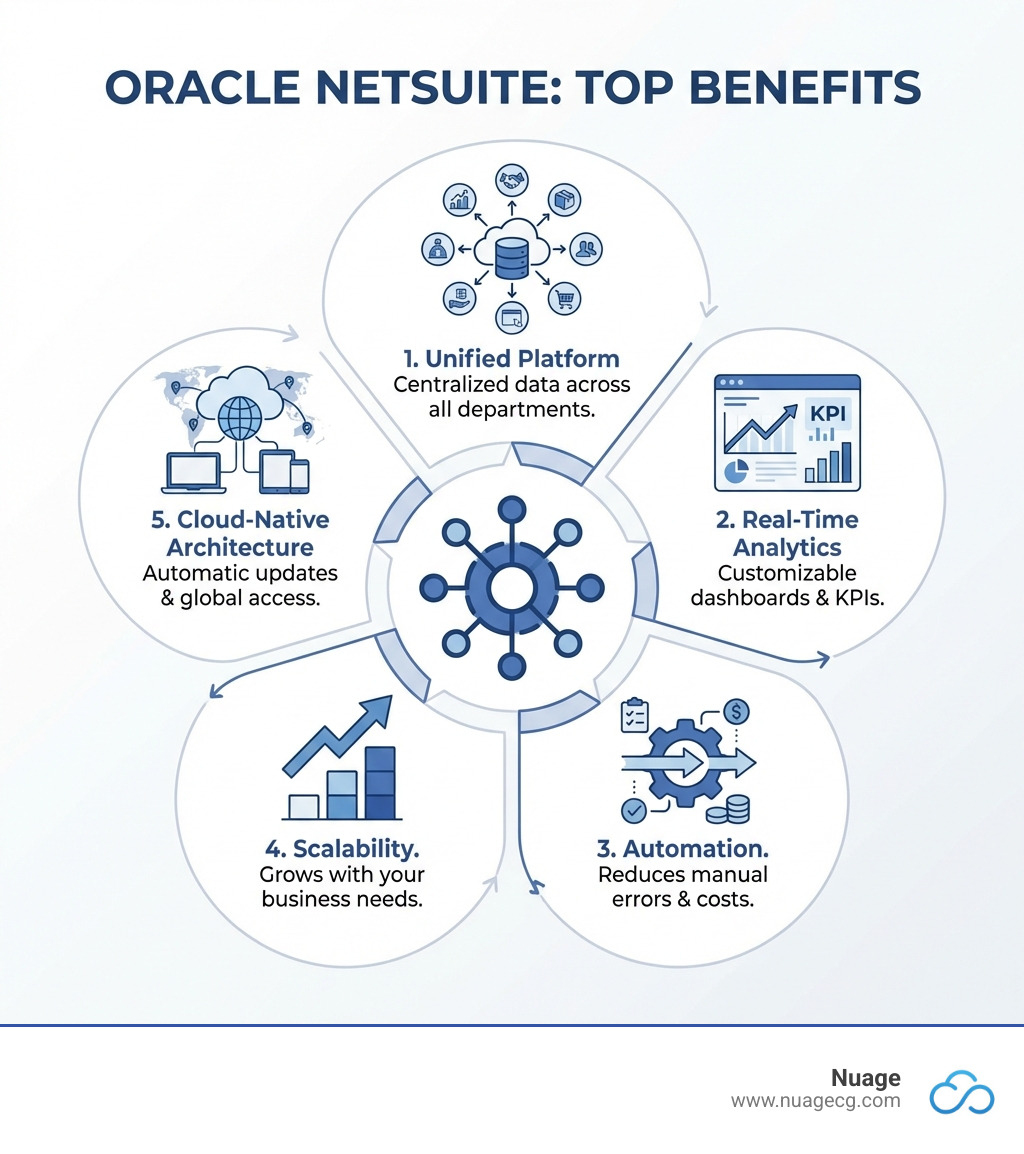
The benefits of Oracle NetSuite transform how businesses operate by unifying finance, CRM, inventory, HR, and ecommerce into one cloud-based platform. Here’s what makes it powerful:
Key Benefits of Oracle NetSuite:
- Unified Platform – All business data in one place, eliminating disconnected systems
- Real-Time Visibility – Customizable dashboards and analytics for smarter decisions
- Automation – Streamline routine tasks like invoicing, order fulfillment, and payroll
- Scalability – Easily add users, modules, and capabilities as you grow
- Cloud-Native – Access from anywhere with automatic updates and no IT overhead
- Integrated CRM – Complete customer view from lead to support case
- Global Ready – Supports 190+ currencies, 27 languages, and multi-entity management
Companies don’t invest in ERP systems for fun—they do it because they’re drowning in inefficiencies. Spreadsheets, disconnected systems, and manual processes create data silos that slow down decision-making and limit growth. NetSuite solves this by acting as your business’s digital backbone, connecting every department to a single source of truth.
Used by over 43,000 organizations across the globe, NetSuite has earned its position as the #1 Cloud ERP. Gartner recognized it as the most sought-after name in “Cloud Core Financial Management Suites for Midsize, Large and Global Enterprises” for four consecutive years through 2021.
The reality? Most businesses only use about 20% of NetSuite’s potential. That’s where optimization comes in. Learn more about NetSuite solutions and how to maximize your investment.
I’m Louis Balla, CRO and partner at Nuage, and I’ve spent over 15 years helping companies open up the benefits of Oracle NetSuite through strategic alignment and system optimization. My focus is helping businesses bridge the NetSuite Divide so they can operate like industry leaders.
A Unified Platform for Total Business Visibility
At its core, Oracle NetSuite is a comprehensive cloud-based business management platform designed to unify various business processes under a single database. It manages essential functions like finance, accounting, inventory, orders, procurement, and can extend to include CRM, HR, Professional Services Automation (PSA), and commerce modules. This integrated approach is a game-changer, especially for small and medium-sized businesses that often juggle a mix of disparate tools, spreadsheets, and standalone applications. We often find that our clients, particularly those in areas like Manhattan Beach, CA, or Jacksonville, FL, are trying to scale rapidly but are held back by fragmented data and a lack of clear oversight.
The true value of an ERP system like NetSuite stems from the clarity, efficiency, and automation it brings to operations. It replaces those disconnected tools, simplifying workflows and drastically reducing manual work. This delivers deep, real-time insights that make businesses more competitive, nimble, and scalable.
Break Down Silos with a Single Source of Truth
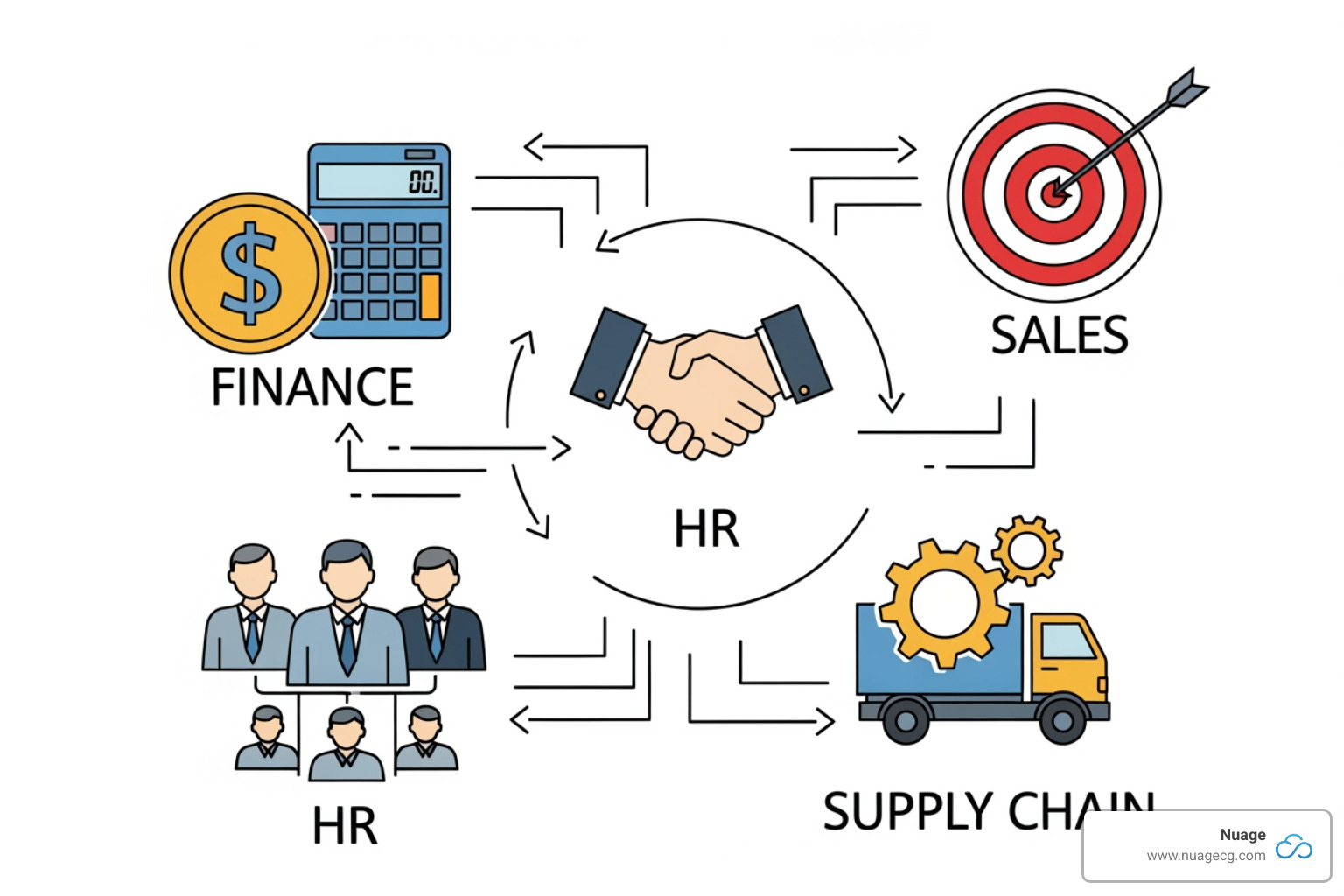
Imagine a world where your finance team isn’t hunting down data across dozens of spreadsheets, and your sales team always knows the exact inventory levels before promising a delivery. That’s the power of NetSuite’s unified platform. By connecting all departmental platforms—marketing, sales, finance, and operations—to one core system, NetSuite eliminates data silos. This means data entered in one area is immediately available and consistent across all relevant departments, creating a single source of truth.
This integrated approach means that finance and operations data, sales and customer data, and even HR information are all speaking the same language. This prevents the kind of inconsistent information that leads to errors, delays, and frustrated employees. Life without an ERP, as some say, is like a cheeseboard without Brie – something always feels missing! For a deeper dive into how this integration works, explore our guides on NetSuite ERP Integration and NetSuite Integrations.
Drive Smarter Decisions with Real-Time Analytics
What good is data if you can’t access it when you need it, or understand what it means? One of the most significant benefits of Oracle NetSuite is its ability to facilitate real-time visibility and data-driven decision-making. NetSuite provides powerful business intelligence tools and real-time visibility through customizable dashboards that display live Key Performance Indicators (KPIs). You can access a 360-degree view of your business performance, making it easier to control processes, pinpoint errors, and make informed decisions.
These dashboards are not just pretty pictures; they offer drill-down capabilities, allowing you to go from high-level summaries to underlying transaction details with a click. This means managers can make faster, better decisions because they have all the relevant context, rather than relying on hunches. For example, a purchasing team can see the status of in-transit orders, factoring this into new orders to avoid stock imbalances. This immediate access to accurate, up-to-the-minute data is critical in today’s environment. Learn more about using this power with NetSuite Dashboards, Suite Analytics, and NetSuite Reporting Tools.
The Top Benefits of Oracle NetSuite for Growing Businesses

For small and medium-sized businesses, the journey from startup to enterprise can be fraught with operational challenges. This is where NetSuite truly shines, providing the strategic growth tools and operational excellence needed to scale. It offers a clear path to return on investment (ROI) by streamlining operations and improving decision-making. We’ve seen how our clients in Florida, particularly around Ponte Vedra and Jacksonville, leverage these capabilities to transform their growth trajectory.
Achieve Peak Efficiency Through Automation
One of the most impactful benefits of Oracle NetSuite is its ability to automate numerous routine business processes. Think about the time your team spends on repetitive tasks like accounts payable/receivable, order fulfillment workflows, inventory counts, or month-end financial close procedures. NetSuite automates these, significantly reducing manual effort and minimizing human error. It’s like having a digital assistant that handles all the mundane stuff, freeing your employees to focus on more strategic, revenue-generating activities.
For instance, the NetSuite AP Automation module allows you to email or drag and drop vendor invoices directly into NetSuite, removing manual data entry and automating the entire invoice capture and payment process. This not only saves time but also leads to significant cost reductions. We often tell our clients that automating processes with NetSuite isn’t just about cutting costs; it’s about making your business more agile and responsive. Explore more about optimizing your operations with NetSuite Process Automation Tips 2025 and strategies for NetSuite Cost Reduction.
Improve Customer Relationships with Integrated CRM
In today’s competitive landscape, customer relationships are paramount. NetSuite’s integrated CRM functionality provides a complete 360-degree customer view, giving your sales, marketing, and customer service teams access to the same up-to-date information from lead to support case. This comprehensive understanding allows for personalized marketing campaigns, more effective sales conversations, and faster, more satisfactory customer support resolutions.
Imagine your customer service representative instantly knowing a customer’s entire order history, previous interactions, and preferences. This leads to faster solutions, increased customer satisfaction, and ultimately, higher loyalty and retention. This isn’t just about managing customer data; it’s about nurturing relationships and identifying new upsell and cross-sell opportunities. For a detailed look at how this integration can benefit your business, check out our CRM NetSuite Integration Complete Guide and learn about NetSuite CRM Modules.
A Closer Look at the Financial Benefits of Oracle NetSuite
Financial management is the backbone of any healthy business. NetSuite provides advanced financial management tools that go far beyond basic accounting software. It covers everything from general ledger to accounts payable and receivable, budgeting, and financial reporting. For businesses with multiple entities or global operations, NetSuite offers multi-entity and multi-currency consolidation, facilitating faster financial close cycles and providing accurate, timely insights for better decision-making.
Compliance management is also significantly improved. NetSuite ensures financial data is accurate, secure, and audit-ready with comprehensive audit trails, role-based security, and built-in support for various accounting standards and regulations like SOX. This makes staying compliant a breeze, rather than a monthly headache. Strategic financial management becomes much more proactive when you have all your data in one place. Dive deeper into these capabilities with our resources on NetSuite Finance Modules and NetSuite Budgeting and Planning.
Optimize Your Supply Chain and Inventory
Managing your supply chain and inventory effectively is crucial for profitability and customer satisfaction. NetSuite ERP manages core functions like inventory, orders, and procurement, offering advanced features such as demand planning, real-time tracking, automatic replenishment, and warehouse management. This comprehensive control helps optimize inventory levels, preventing costly stockouts or excess inventory, and significantly improving order fulfillment accuracy.
For example, a manufacturer can identify its least profitable products through NetSuite’s analysis, find high manual labor costs, and then automate production to increase profit margins. The system can even suggest purchase orders, work orders, and transfer orders across multiple locations. From quote to cash, NetSuite streamlines the entire order management process, centralizing pricing, billing, invoicing, and fulfillment. This leads to smoother operations and happier customers. Explore how to master your inventory with NetSuite Inventory Management, streamline orders with NetSuite Order Management, and optimize purchasing with NetSuite Advanced Procurement Complete Guide.
Built for the Future: Scalability and Flexibility in the Cloud
One of the most compelling benefits of Oracle NetSuite is its cloud-native architecture. Unlike many legacy ERP systems that were retrofitted for the cloud, NetSuite was “born in the cloud” in 1998 as NetLedger. This true cloud, multi-tenant design means all customers run on the same software version and infrastructure, benefiting from continuous innovation with regular, automatic updates without the disruption of manual upgrades. This ensures your business is always on the latest technology, effectively future-proofing your operations. Check out Why NetSuite? for more on its pioneering history.
Scale Seamlessly as Your Business Expands
Growth is exciting, but it can also be painful if your systems can’t keep up. NetSuite is designed to grow with your business, offering true scalability and flexibility. You can easily add users, modules, and features as your needs evolve, or expand into new geographical locations without the upheaval of re-platforming. This modular structure means you only pay for what you need now and can seamlessly add capabilities later.
Whether you’re a small business in California looking to expand or an enterprise managing multi-subsidiary operations across different states, NetSuite handles increasing transaction volumes, more intricate supply chains, and the demands of multi-entity or multi-national operations. NetSuite supports more than 190 currencies, 27 languages, and automated tax compliance in over 100 countries, making global expansion a much smoother process. For insights into how NetSuite supports businesses of all sizes, refer to NetSuite for Small Business and NetSuite for Enterprise.
Customize and Extend with the SuiteCloud Platform
Every business is unique, and NetSuite understands that. Its SuiteCloud platform provides a robust set of tools that allow you to tailor the system to your exact requirements without compromising future upgrades. This includes:
- SuiteBuilder: For creating custom fields, forms, and records.
- SuiteFlow: For point-and-click process automation, building workflows for approvals and business rules.
- SuiteScript: A JavaScript-based platform for deep customization and complex business logic.
- SuiteTalk: For powerful third-party integrations using SOAP/REST APIs.
Beyond these native tools, the vast catalog of SuiteApps developed by Oracle NetSuite and partners, offering additional functionality or integrations with other SaaS solutions. This extensibility ensures NetSuite can adapt to your evolving business needs. If you’re considering bespoke solutions, our Custom NetSuite Development Guide and NetSuite ERP Customization articles provide comprehensive information.
Understanding NetSuite Implementation and Pricing
Starting on an ERP implementation can seem daunting, but with the right approach, it can be a smooth and transformative journey. At Nuage, we guide our clients through this process, ensuring they open up the full benefits of Oracle NetSuite.
How Does the NetSuite Implementation Process Work?
NetSuite uses its proven SuiteSuccess implementation methodology, which tailors the deployment to your business based on its industry and size. This leverages industry-leading practices for faster deployments and rapid time-to-value. Many companies go live in 100 days or less, a testament to this efficient approach.
A typical NetSuite ERP implementation involves several phases:
- Planning and Discovery: Defining your business requirements, goals, and project scope.
- Configuration: Setting up NetSuite to align with your specific processes and data.
- Data Migration: Moving your existing data into the new NetSuite system.
- Testing and Training: Ensuring the system works as expected and preparing your team for the transition.
- Go-Live and Support: Launching NetSuite and providing ongoing assistance.
Minimizing business disruption during this period is key, and we achieve this through a well-defined project plan, a phased rollout approach, and thorough data migration planning and validation. Successful user adoption hinges on comprehensive, custom training and effective change management. For more detailed information, consult our NetSuite Implementation Guide and learn about working with a dedicated NetSuite Implementation Company.
How Is NetSuite Pricing Determined?
NetSuite operates on a subscription model, which shifts your IT spend from a capital expenditure (CapEx) to a more predictable operational expenditure (OpEx). This is often financially attractive for growing companies looking to conserve cash.
The annual license fee for NetSuite is primarily comprised of three main components:
- Core Platform: The foundational ERP functionalities.
- Optional Modules: Specific features you choose to add, such as advanced inventory, CRM, or e-commerce.
- Number of Users: The total number of individuals who will access the system.
There is also a one-time implementation fee for the initial setup, which varies based on the scope and complexity of your project. The beauty of this model is its scalability; you can activate new modules and add users as your business grows, ensuring your ERP solution always aligns with your needs without overspending. For a deeper understanding of the financial considerations, our NetSuite Implementation Costs article provides valuable insights.
Frequently Asked Questions about the Benefits of Oracle NetSuite
What are the most common business challenges NetSuite helps solve?
We frequently encounter businesses struggling with a myriad of operational headaches. NetSuite is expertly designed to solve many common business challenges, including:
- Disconnected Systems: Replacing disparate software and spreadsheets with a unified platform.
- Manual Data Entry: Automating routine tasks to reduce errors and save time.
- Poor Visibility into Operations: Providing real-time data and customizable dashboards for a 360-degree view.
- Difficulty Scaling: Offering a modular structure that grows with your business, handling increased complexity and volume.
- Inefficient Reporting: Generating agile, accurate reports on demand, eliminating the need for manual data compilation.
NetSuite helps businesses overcome inefficiencies that hinder growth and profitability, offering a comprehensive solution for streamlined operations. Find more about the extensive advantages in 15 Benefits of ERP for Businesses in 2025.
How does NetSuite compare to basic accounting software?
While basic accounting software like QuickBooks is excellent for managing fundamental financial transactions, NetSuite offers a full business suite that goes far beyond. The distinction is like comparing a bicycle to a fully integrated, high-performance vehicle.
NetSuite provides:
- Integrated Modules: Unifying not just accounting, but also CRM, inventory, HR, supply chain, and e-commerce.
- Advanced Reporting: Deep, customizable analytics and real-time KPIs across all business functions.
- Scalability for Growth: Designed to support businesses from startups to large enterprises, easily accommodating increased users and complexity.
- Comprehensive Capabilities: From automated order management to demand planning and global financial consolidation.
For businesses that are growing beyond simple financial tracking and need to manage their entire operation from one platform, NetSuite is the clear choice. We often help clients transition from basic accounting software when they realize its limitations. For a detailed comparison, explore our QuickBooks vs NetSuite analysis.
How does NetSuite ensure data security and compliance?
Data security and compliance are non-negotiable in today’s business world. NetSuite understands this deeply and is built with robust security features to safeguard your critical information. Key aspects include:
- Role-Based Access: Granular permissions ensure employees only see the information relevant to their role, reducing opportunities for fraud or unauthorized access.
- Robust Data Centers: NetSuite’s data centers adhere to stringent international security standards and certifications, offering redundancy across multiple remote servers.
- Comprehensive Audit Trails: Every action within the system is logged, providing an unalterable record for audit purposes and accountability.
- Built-in Compliance Features: The system supports specific financial standards like GAAP and regulations such as the Sarbanes-Oxley Act (SOX), with features designed to ease compliance.
By centralizing data in a secure, controlled environment, NetSuite significantly increases the level of protection compared to data spread across multiple, unsecured systems. Our NetSuite SOX Compliance Guide provides further detail on how NetSuite supports regulatory adherence.
Conclusion: Open up Your Business Potential with NetSuite
The benefits of Oracle NetSuite are clear: a unified, cloud-native platform that drives efficiency, improves visibility, and provides the scalability and flexibility needed for sustained growth. From automating routine tasks and optimizing your supply chain to fostering stronger customer relationships and ensuring robust financial management, NetSuite empowers businesses to operate smarter, not harder.
It’s a strategic investment that transforms operational challenges into opportunities for growth and agility. As your NetSuite Optimization Engine, we at Nuage, with our presence in California and Florida, are dedicated to helping you maximize your investment, ensuring you harness every ounce of NetSuite’s potential. Don’t let inefficiencies hold your business back.
Speak to our NetSuite experts to see how these benefits apply to your business and open up the next level of operational excellence.