

Why Global Enterprises Need Modern Cloud ERP

NetSuite for enterprises delivers a unified, cloud-based ERP and omnichannel commerce platform that helps large organizations manage complex global operations, consolidate financials, and drive agility. Key benefits include:
- Unified Platform: A single system for ERP, financials, CRM, and ecommerce eliminates data silos.
- Global Capabilities: Out-of-the-box support for multi-currency, multi-language, and multi-subsidiary consolidation.
- Rapid Deployment: A two-tier ERP strategy enables fast integration of acquisitions and new markets.
- AI-Powered Insights: Embedded AI connects data across all functions for better decision-making.
- Industry-Specific Solutions: Pre-configured for technology, manufacturing, distribution, and other sectors.
- Enterprise Performance Management: Integrated planning, budgeting, forecasting, and financial close processes.
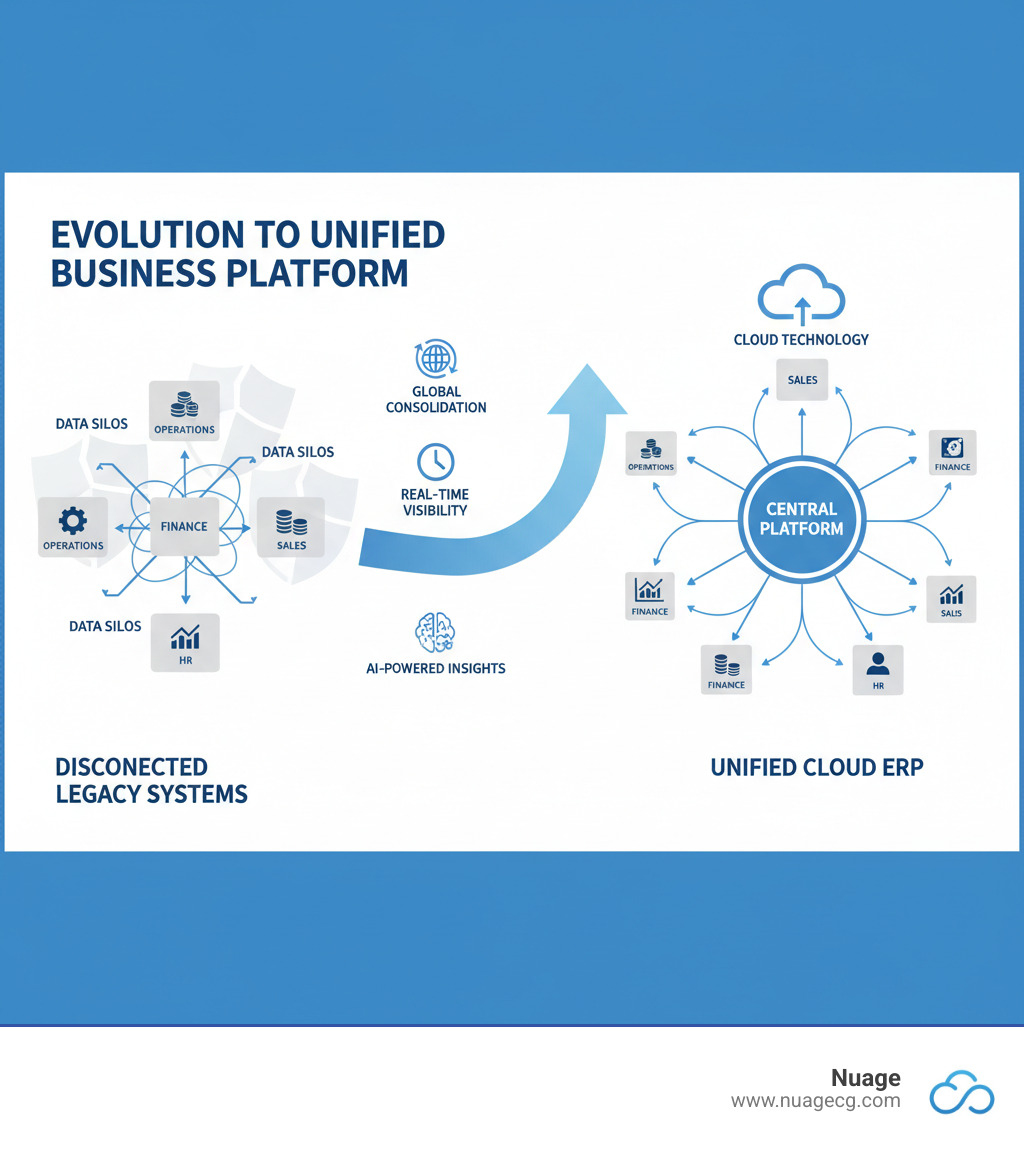
In today’s economy, large organizations face intense pressure. Legacy on-premise ERP systems create bottlenecks, trapping data in silos, slowing M&A integration, and delaying international expansion. These aren’t just operational headaches; they directly impact your ability to compete and grow.
Oracle NetSuite was founded in 1998 as the world’s first cloud company and now serves over 43,000 customers in 219 countries, including roughly 20% of Fortune 100 companies. Unlike legacy systems adapted for the cloud, NetSuite is a true cloud-native platform built for scale. It provides a unified business system that connects every function—from financial consolidation to supply chain management—in real time.
This means your teams work from a single source of truth. Your CFO sees consolidated global financials instantly, your operations manager tracks inventory across countries, and your sales team accesses complete customer history without switching systems. As Arvind Sathyamoorthy, Sr. Director at Omnicell, explains: “NetSuite plays a critical role in our two-tier ERP strategy, providing a way to quickly consolidate new business segments, acquisitions, and markets.”
I’m Louis Balla, CRO and partner at Nuage. With over 15 years in digital change and supply chain optimization, I’ve seen how the right approach to NetSuite for enterprises transforms businesses from struggling with 20% utilization to operating at peak efficiency.
Important NetSuite for enterprises terms:
Navigating Global Complexity with a Unified Platform
Running a global enterprise means managing diverse business models—B2B, B2C, and B2X—across different regulatory frameworks, tax codes, and currencies. This complexity can quickly become overwhelming.
NetSuite for enterprises shines by replacing this complexity with a unified cloud platform. It provides the flexibility to handle any business model while maintaining a consistent customer experience across every channel. You can explore the full scope of these capabilities at NetSuite for Enterprises.

Addressing Core Enterprise Challenges
NetSuite directly addresses core challenges like data fragmentation and a lack of real-time visibility. When sales, inventory, and financial data live in separate systems, decisions are delayed and teams waste hours reconciling spreadsheets. Inefficient, manual processes make it impossible to scale effectively.
NetSuite’s unified data model solves this. As an all-in-one, AI-powered cloud solution, it automates core processes while providing real-time visibility into operational and financial performance. With clear visibility into your data and tighter control over your business, you can run your enterprise proactively instead of constantly reacting to problems.
Enabling Global Growth and Omnichannel Commerce
Global expansion often comes with a daunting list of challenges, from navigating unfamiliar regulations to managing multiple currencies. Many organizations delay growth simply because their systems can’t handle the complexity.
NetSuite removes these barriers. With built-in multi-subsidiary management, multi-language support, and multi-currency transactions, you get the infrastructure to operate seamlessly across borders. NetSuite OneWorld was built to help companies manage global operations without drowning in complexity. Whether you’re entering new markets or managing dozens of subsidiaries, the platform scales with you, ensuring a unified experience across all channels for your customers.
At Nuage, we’ve helped many enterprises transition from fragmented regional systems to a truly unified global platform. The difference in agility is remarkable once you’re working from a single source of truth.
Driving Financial Excellence with NetSuite for Enterprises
For a large enterprise, basic accounting software isn’t enough. You need a system that ties everything together, automates tedious work, and helps you make smarter decisions. This is where NetSuite for enterprises changes how organizations manage their finances, inventory, and supply chains.

NetSuite ERP eliminates chaos by giving you clear visibility into your data and tighter control over your business. It automates core processes across accounting, orders, inventory, supply chain, and warehouse operations in one unified system. The real-time visibility into both operational and financial performance means everyone works from the same truth. For a breakdown, see this video: What is NetSuite ERP and How Does It Work? (Video).
Streamlining Financials with Enterprise Performance Management (EPM)
Financial planning in large organizations often means drowning in spreadsheets. NetSuite Enterprise Performance Management (EPM) brings sanity to this process. Built from the Oracle Fusion Cloud EPM solution, it unites financial planning, budgeting, forecasting, account reconciliation, and financial close processes in one system.
This means your finance team can produce budgets and forecasts quickly, model what-if scenarios, and generate reports without manual data consolidation. The system frees your team to focus on analysis and strategy. Account reconciliation and the financial close process become dramatically faster and more accurate as the system automates tasks and data aggregation. For more, watch this video: What is NetSuite Enterprise Performance Management? (Video). For insights on using real-time data, see this guide: Improving Forecasts and Budgets With Real–time Data and AI (Guide).
Core Benefits of NetSuite ERP for Enterprises
When you automate financial processes like accounts payable and receivable, you free your finance team for more strategic work. Procure-to-pay and order-to-cash automation streamline workflows, reduce errors, and accelerate revenue recognition.
With real-time inventory visibility, you can monitor stock levels across all locations, set intelligent reorder points, and reduce carrying costs. This leads to impressive supply chain efficiency gains, as you can control the flow of goods from procurement to final delivery. The result is tighter business control and the operational awareness to make confident, timely decisions.
Fueling Agility and Innovation Across the Enterprise
Large enterprises shouldn’t be slow to maneuver. Yet, that’s what happens with rigid legacy systems. The modern enterprise needs to move with the speed of a startup, even while managing global operations.

NetSuite for enterprises delivers this agility. It’s a platform built for change, adapting as your business evolves. Whether you’re launching a new product, acquiring a competitor, or expanding into a new region, NetSuite flexes with you. This flexibility extends across different industries, with specific functionality that addresses unique sector challenges, from technology to manufacturing.
Adapting to Change: M&A and Divestitures
Strategic acquisitions often lead to months of painful system integration, trapping value behind technical barriers. NetSuite for enterprises changes this with a two-tier ERP strategy. You can rapidly integrate acquisitions onto NetSuite in weeks, gaining immediate visibility and consolidated reporting from day one.
This approach opens up shareholder value faster. A two-tier strategy means keeping your corporate headquarters on a Tier 1 system while using NetSuite as the agile Tier 2 solution for subsidiaries and new divisions. It’s cost-effective, fast to deploy, and eliminates the complexity of forcing every entity onto a single heavyweight platform. As Arvind Sathyamoorthy of Omnicell notes, NetSuite is critical for their ability “to quickly consolidate new business segments, acquisitions, and markets.”
A Platform for Industry-Specific Growth: The Tech Sector Example
The tech sector is a prime example. NetSuite for enterprises was built to handle the industry’s unique pressures, from automated recurring billing and complex revenue recognition (ASC 606) to Professional Services Automation (PSA). It supports companies through every growth phase, from securing funding to preparing for an IPO, by providing sophisticated financial management and operational control in a single platform.
NetSuite’s flexible architecture addresses the specific needs of many industries, including manufacturing, wholesale distribution, and retail. You can learn more about how NetSuite supports different business models and industries on our dedicated page. The bottom line is that agility is the difference between capturing market opportunities and watching competitors pass you by.
The AI Advantage: Opening Up Unified Business Insights
Artificial intelligence is only as good as the data you feed it. If your AI pulls from disconnected, siloed systems, you’re getting expensive guesswork, not real insights.
This is where NetSuite for enterprises changes the game.
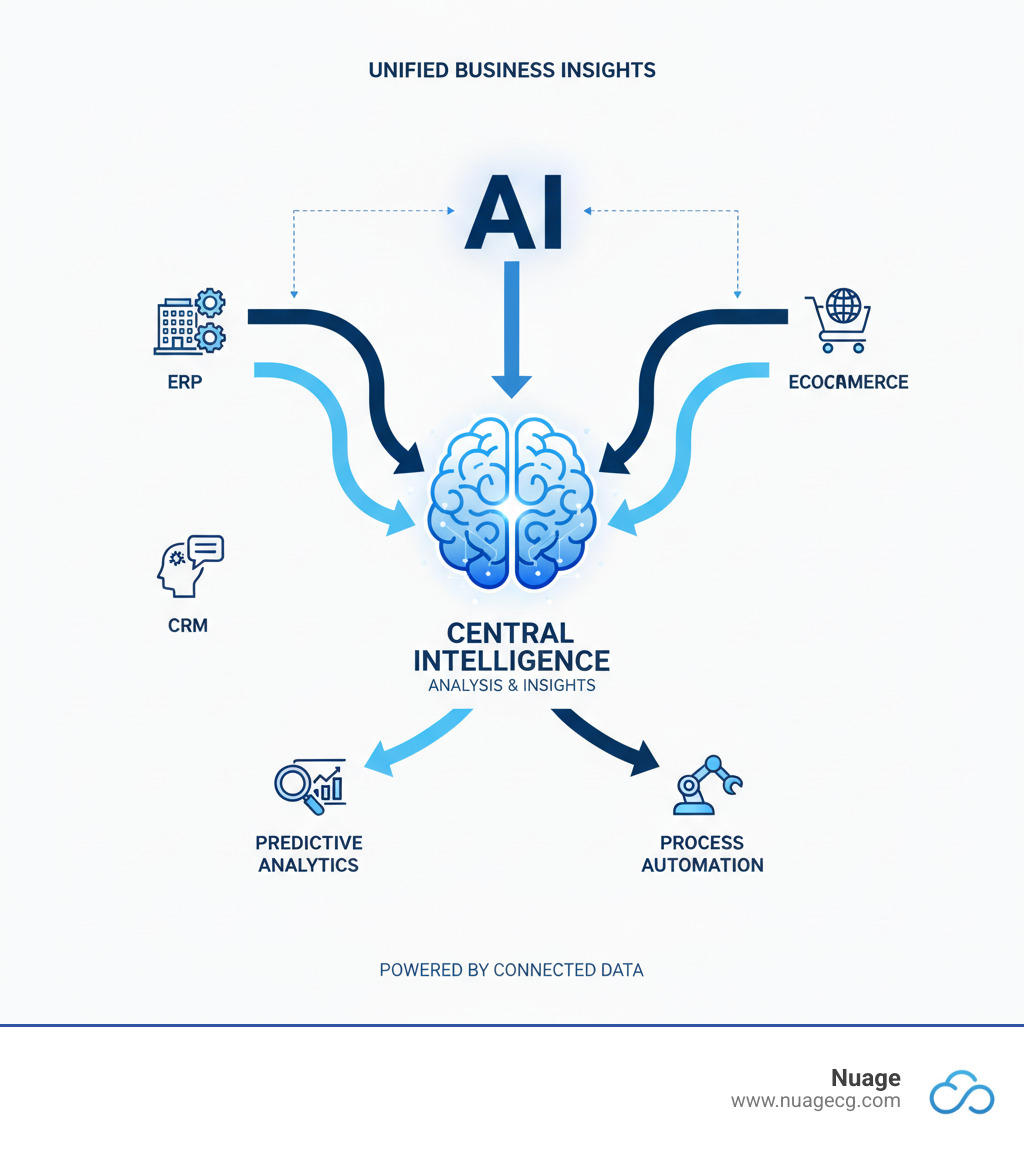
As the #1 AI Cloud ERP, NetSuite solves the data problem first. By creating a true single source of truth where financial, customer, and operational data live together in real time, it enables genuine predictive analytics and intelligent automation.
Connecting Data for a Single Source of Truth
NetSuite’s integrated suite brings together ERP/financials data, CRM customer information, and ecommerce transactions into one unified platform. This eliminates the chaos of reconciling different versions of the truth from separate departmental systems.
When AI has access to unified data, it can identify patterns humans can’t see, like predicting which customers will churn or flagging supply chain risks. This comprehensive view transforms decision-making. Instead of debating whose numbers are right, leadership teams work from shared facts and spot trends in real time.
How NetSuite’s Embedded AI Delivers Value
NetSuite’s AI capabilities are woven throughout the platform, working to make your teams more effective. For example, AI-powered bill capture automatically extracts invoice data, saving hours of manual entry. The system also detects financial anomalies, suggests optimal inventory levels by analyzing sales patterns, and provides intelligent recommendations to sales teams about which prospects are ready to buy.
The beauty of this approach is that you don’t need a team of data scientists to benefit. The AI works for everyone, simplifying complex tasks and uncovering hidden opportunities. The key is the unified data foundation that NetSuite provides by design. You can learn more about how we help companies maximize these capabilities on our NetSuite page.
Accelerating Time-to-Value with SuiteSuccess
Implementing a new ERP system in a large enterprise is a high-stakes endeavor. Traditional implementations can be long, costly, and disruptive. NetSuite’s SuiteSuccess methodology changes this dynamic entirely.
SuiteSuccess is built on over 25 years of experience from tens of thousands of implementations. It’s the collective wisdom of what works, distilled into a repeatable framework that gets enterprises running faster, with better ROI and higher employee adoption.
The methodology provides pre-configured roles, dashboards, and KPIs specific to your industry, so you start with a system already optimized with leading practices. You’re not beginning with a blank canvas.
The phased implementation approach is another game-changer. Instead of trying to do everything at once, SuiteSuccess helps you deploy core functionalities quickly and then expand systematically. You get immediate value while your team builds confidence.
SuiteSuccess is about business change, not just software deployment. It guides you on how to consume and optimize NetSuite for enterprises to its full potential, preventing the common problem of underutilization.
At Nuage, we use the SuiteSuccess framework as the foundation for our services. As your NetSuite Optimization Engine, we help you determine the right solution and implement it to drive real business results, ensuring your investment delivers value from day one.
Frequently Asked Questions about NetSuite for Enterprises
How does NetSuite handle the complex regulatory and tax needs of a global enterprise?
NetSuite OneWorld is designed for the complexities of global operations. It provides multi-subsidiary consolidation, allowing you to manage multiple legal entities, business units, and currencies in a single system. It supports country-specific tax and regulatory compliance in over 219 countries, with built-in tax engines and frameworks. With multi-language and multi-currency support, your global teams can work seamlessly while the system provides real-time visibility and ensures compliance.
Can NetSuite truly scale to support a large, complex enterprise?
Yes. NetSuite for enterprises has proven scalability, serving over 43,000 customers, including roughly 20% of Fortune 100 companies. Its cloud-native architecture was built for scale and flexibility, unlike legacy systems retrofitted for the cloud. It handles complex business models, multi-entity management, and global consolidation without requiring major IT infrastructure changes. As your business grows, NetSuite scales with you.
What is a two-tier ERP strategy and how does NetSuite support it?
A two-tier ERP strategy involves using a core Tier 1 ERP at the corporate level while deploying a more agile Tier 2 ERP for subsidiaries or new divisions. NetSuite excels as a Tier 2 solution. It allows for the rapid deployment of new acquisitions or business units at a lower cost than extending a legacy Tier 1 system. This gives subsidiaries the tools they need while allowing for seamless data consolidation back to corporate, providing the best of both worlds: centralized control and local agility. You can learn more about how NetSuite enables this flexibility on our NetSuite services page.
Conclusion: Your Partner in Enterprise Change
The challenges facing global enterprises are complex, requiring more than just software—they need a true business change partner.
NetSuite for enterprises provides the foundation for this change. As we’ve explored, NetSuite delivers the agility, visibility, and control modern enterprises need. It replaces data silos with a unified, AI-powered cloud platform, enabling you to integrate acquisitions, expand globally, and move faster as an organization.
But powerful software is only half the battle. The real magic happens when you have the right partner to help you get the most out of it.
At Nuage, we’ve spent over 20 years guiding enterprises through digital change. We don’t just sell software; we help you determine the right solutions for your specific challenges. Think of us as your NetSuite Optimization Engine. We partner with you from evaluation through implementation and beyond, ensuring you leverage NetSuite’s full potential and avoid common pitfalls.
Our team has helped companies transform from struggling with low system utilization to operating at peak efficiency. From our offices in Manhattan Beach, CA, and Jacksonville, FL, we serve clients around the globe, asking the right questions to chart the smoothest path forward.
Ready to transform how your enterprise operates? Let’s talk about how NetSuite and Nuage can help you thrive in today’s competitive landscape.
Optimize Your Enterprise with Nuage’s NetSuite Services