

Why Connect NetSuite and DHL?
NetSuite DHL integration connects your ERP system directly with DHL’s shipping services, eliminating manual data entry and streamlining your entire fulfillment process. Here’s what you can accomplish:
Quick Answer: NetSuite DHL Integration Essentials
- Automate shipment creation – Sales orders automatically trigger DHL shipments
- Generate labels instantly – Print DHL shipping labels directly from NetSuite
- Track in real-time – Tracking numbers sync back to sales orders automatically
- Calculate accurate rates – Get live DHL shipping rates during order processing
- Reduce errors – Eliminate manual data entry between systems
- Save time – Process shipments in bulk instead of one-by-one
If you’re using NetSuite to manage your business operations, you already know how powerful it is for managing orders, inventory, and customer data. But when it comes to shipping, many companies still find themselves copying information from NetSuite into DHL’s system, printing labels separately, and manually updating tracking numbers back into NetSuite.
This manual process creates three major problems:
Shipping delays – Every manual step adds time to your fulfillment process. When employees have to log into multiple systems and copy data back and forth, orders sit waiting instead of shipping.
Costly errors – Manual data entry means typos in addresses, wrong shipping methods, and lost tracking numbers. These mistakes frustrate customers and create extra work for your team.
Lost visibility – Without integration, you can’t see your shipping data in real-time. You’re forced to run separate reports from NetSuite and DHL, then try to match them up manually.
The good news? A proper NetSuite DHL integration solves all three problems. It creates a direct connection between your ERP and DHL’s shipping platform, so data flows automatically in both directions. Your team saves hours every day, customers get accurate tracking information immediately, and you gain complete visibility into your shipping operations.
As Louis Balla, I’ve spent over 15 years helping companies optimize their NetSuite implementations, including building and installing third-party apps that improve shipping capabilities through NetSuite DHL integration. At Nuage, we specialize in helping businesses bridge the NetSuite divide and open up the full potential of their ERP investment.
The Core Benefits of Integrating DHL with NetSuite
Integrating DHL with your NetSuite ERP isn’t just about making shipping easier; it’s about fundamentally changing your logistics, reducing costs, enhancing inventory accuracy, and ultimately, delighting your customers. We consistently observe that businesses leveraging NetSuite DHL integration experience a significant uplift in operational efficiency and customer satisfaction.
Reduced Operational Costs
One of the most immediate and tangible benefits we see our clients achieve with NetSuite DHL integration is a substantial reduction in operational costs. How does this happen?
- Optimized Shipping Rates: By integrating, you can access real-time rate shopping, allowing you to dynamically select the most cost-effective DHL service based on package dimensions, weight, and destination. This ensures you’re always getting the best price for each shipment.
- Reduced Labor Costs: Automating tasks like shipment creation, label generation, and tracking updates means your team spends less time on repetitive, manual data entry. This frees up valuable resources, allowing employees to focus on more strategic, value-added activities rather than tedious clerical work.
- Elimination of Data Entry Errors: Manual processes are prone to human error. Every mistake—a wrong address, an incorrect shipping method, a forgotten tracking number—costs time and money to fix. Integration removes the need for manual transcription, drastically cutting down on costly errors and the associated rework.
- Increased Company Output: With streamlined workflows and fewer errors, your business can process more orders in less time. This increased throughput translates directly into higher sales volume and revenue potential without needing to scale up your workforce proportionally.
Improved Data and Inventory Accuracy
For any business, accurate data is the bedrock of good decision-making. NetSuite DHL integration lifts data and inventory accuracy to new heights:
- Single Source of Truth: By syncing DHL data directly with NetSuite, your ERP becomes the definitive “single source of truth” for all shipping-related information. This eliminates data silos and ensures that everyone in your organization, from sales to customer service, is working with the most current and accurate information.
- Real-time Inventory Sync: Integration helps maintain optimal stock levels by providing real-time visibility into your inventory. As orders are fulfilled and shipments are created, NetSuite’s inventory management system is updated instantly. This prevents stockouts and overstocking, which are both costly problems.
- Accurate Fulfillment Records: Every detail of the shipment—from the chosen service to the tracking number—is accurately recorded and linked to the corresponding sales order and item fulfillment record within NetSuite. This historical data is invaluable for reporting, analysis, and auditing.
- NetSuite as a Central Hub: We help our clients leverage NetSuite’s robust capabilities to act as the central hub for all business data, including shipping. This ensures consistency and reliability across your entire operation.
Improved Customer Satisfaction
Happy customers are repeat customers. NetSuite DHL integration plays a pivotal role in enhancing the customer experience:
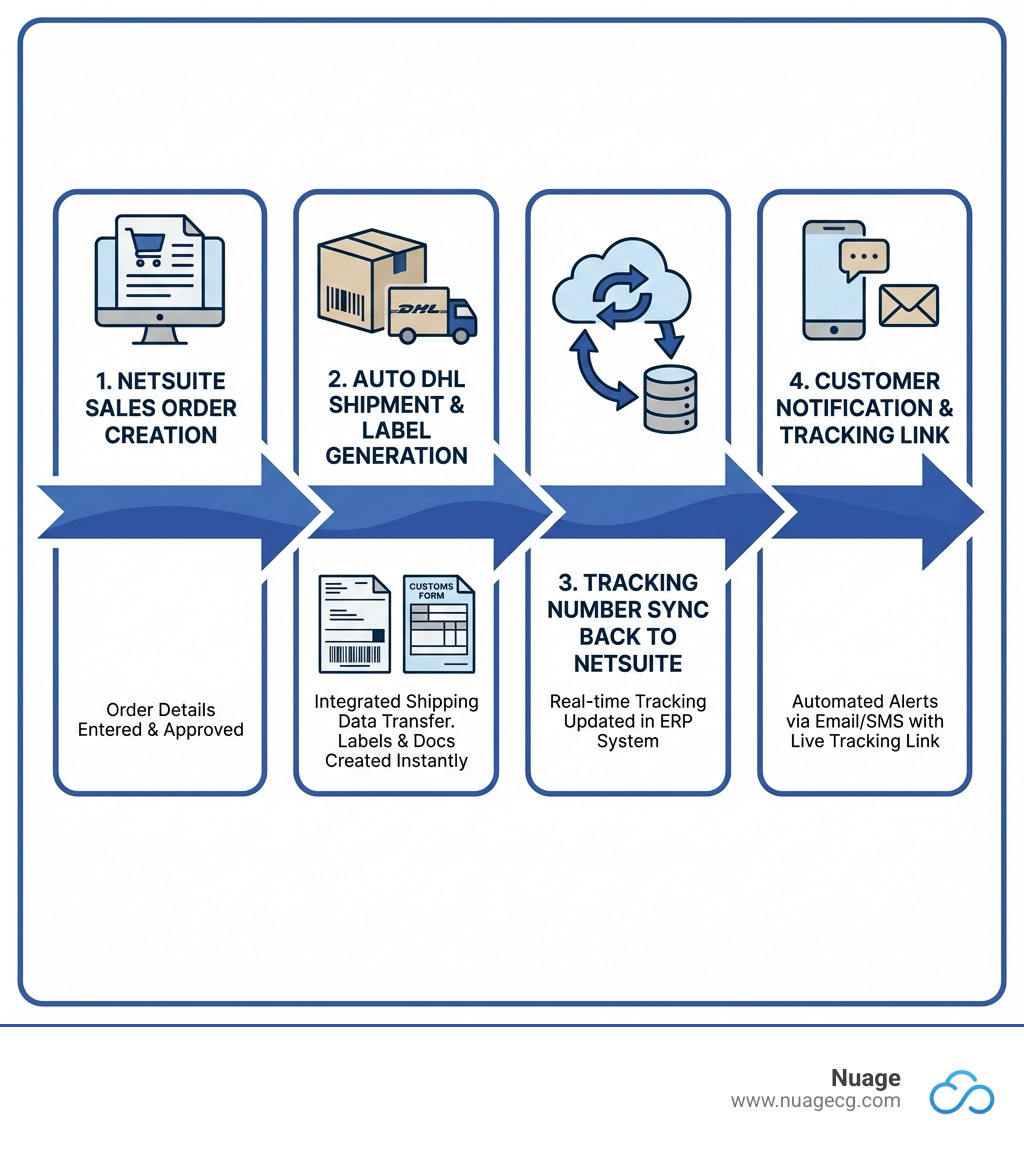
- Automated Shipment Notifications: As soon as an order ships, customers can receive automated email or SMS notifications directly from NetSuite, complete with their DHL tracking link. This proactive communication keeps them informed and reduces anxiety.
- Real-time Tracking Links: Customers can track their packages in real-time through DHL’s system, accessible via links provided directly from their order status in NetSuite. This transparency builds trust and confidence.
- Faster Delivery Times: By streamlining your internal processes and reducing fulfillment delays, orders get out the door faster, leading to quicker delivery times.
- Reduced Shipping Inquiries: Proactive notifications and easy access to tracking information mean fewer customers calling or emailing your support team asking, “Where’s my order?” This frees up your customer service representatives to handle more complex issues.
- Professional Branded Tracking: Some integrations allow for branded tracking portals, further enhancing the professional image of your business.
How NetSuite DHL Integration Automates Your Shipping Workflow
Imagine a world where your orders practically ship themselves. That’s the reality with a robust NetSuite DHL integration. This powerful connection automates critical steps in your shipping workflow, changing what used to be a series of manual tasks into a seamless, efficient process.
Automated Shipment Creation and Label Generation
This is where the magic truly begins. Once a sales order in NetSuite is approved and ready for fulfillment, the integration springs into action:
- Automatic Order Sync: The sales order data—customer address, items, quantities, shipping method—is automatically transferred from NetSuite to the DHL system. There’s no need for your team to re-enter anything.
- Sales Order to Shipment: The integration uses this data to automatically create a DHL shipment.
- Bulk Label Printing: For businesses with high order volumes, the ability to generate and print DHL shipping labels in bulk directly from NetSuite is a game-changer. This saves immense amounts of time compared to processing labels one by one.
- Packing Slips and Barcode Labels: Beyond just the shipping label, the integration can also facilitate the generation of associated documents like packing slips, all synchronized with your NetSuite records. Barcode labels are automatically generated, ensuring accurate scanning throughout the DHL network.
- Fulfillment Record Linking: Crucially, the generated shipping label and its associated details (like the tracking number) are automatically linked back to the item fulfillment record within NetSuite. This creates a complete audit trail and ensures data consistency.
Real-Time Rate Shopping and Service Selection
Optimizing shipping costs and delivery speed is a constant balancing act. NetSuite DHL integration empowers you to make informed decisions effortlessly:
- Live Carrier Rates: The integration connects directly to DHL’s API to pull live, accurate shipping rates based on the actual package details (weight, dimensions, destination) and your specific DHL account pricing. This eliminates guesswork and ensures accurate billing.
- API-based Calculation: These rate calculations happen in real-time, often even before the order is fully processed, allowing you to present customers with accurate shipping costs at checkout or to select the most suitable service internally.
- Shipping Rule Configuration: We can help you configure sophisticated shipping rules within NetSuite. For example, automatically select DHL Express Worldwide for international shipments over a certain value, or DHL Economy Select for domestic shipments under a specific weight.
- Cost vs. Speed Analysis: By displaying various DHL service options and their corresponding costs and estimated delivery times, your team can easily compare and select the best option for each order, balancing customer expectations with cost efficiency.
- Dynamic Service Selection: The system can dynamically choose the optimal DHL service based on predefined criteria, further automating decision-making.
- Third-Party Billing: For certain scenarios, the integration can also handle third-party billing, ensuring the correct accounts are charged.
Seamless Shipment Tracking and Status Updates
Once a package leaves your warehouse, the journey isn’t over. Keeping tabs on its progress and communicating with customers is vital:
- Automatic Tracking Number Import: As soon as a DHL shipping label is generated, the unique tracking number is automatically imported and saved to the corresponding sales order and item fulfillment record in NetSuite.
- Sales Order Status Updates: The integration can automatically update the sales order status in NetSuite to “Shipped” or “Fulfilled” once the package is in transit, providing real-time visibility across your organization.
- Item Fulfillment Records: All tracking details are carefully recorded within the item fulfillment records, creating a comprehensive history for each order.
- Customer-facing Tracking Portals: The tracking number can be automatically pushed to customer portals or included in automated email/SMS alerts, allowing customers to easily monitor their package’s journey directly on DHL’s website.
- Automated Email/SMS Alerts: Beyond just sending the initial tracking link, the integration can trigger further automated notifications for delivery exceptions, “out for delivery” status, and successful delivery, significantly improving the customer experience.
- DHL Express Tracking Integration: For time-sensitive shipments, the direct integration with DHL Express tracking provides granular, up-to-the-minute updates.
Choosing Your NetSuite DHL Integration Path: Methods and Solutions
Deciding on the right integration solution for your business can feel like navigating a maze. At Nuage, we understand that there’s no one-size-fits-all answer. We work with our clients in Manhattan Beach, CA, Ponte Vedra, FL, and Jacksonville, FL, to identify the best path forward, whether that’s leveraging existing NetSuite capabilities, utilizing a third-party connector, or developing a custom solution.
Understanding the Different Integration Approaches
When it comes to connecting NetSuite with DHL, you generally have a few primary routes:
- NuageCG’s NetSuite DHL Integration Solutions: We specialize in developing and implementing custom integration solutions that precisely fit your unique business processes. Our deep understanding of NetSuite shipping automation allows us to create seamless connections that go beyond generic offerings. We act as your NetSuite Optimization Engine, ensuring the integration works perfectly with your existing setup and future growth plans.
- SuiteApp Marketplace Connectors: NetSuite’s SuiteApp Marketplace offers a variety of pre-built connectors developed by third-party vendors. These solutions often provide out-of-the-box functionality for common DHL services. While they can offer a quicker deployment for standard needs, they may require customization to align with specific workflows.
- Custom API Development: For businesses with highly unique or complex shipping requirements, a custom integration built using NetSuite’s native SuiteTalk Web Services (SOAP and REST) and DHL’s APIs is an option. This approach offers maximum flexibility and control, allowing you to design the integration exactly as you need it. While it demands more initial resources and technical expertise, it provides a solution perfectly aligned with your business logic. Our team has experience in custom API development, ensuring robust and scalable solutions.
Key Factors in Selecting a Solution or Partner for your NetSuite DHL Integration
Choosing the right approach and partner is crucial for a successful integration. Here’s what we consider with our clients:
- Business Requirements: What are your must-have features? Do you need advanced rate shopping, specific international documentation, or complex shipping rules? Clearly defining these will guide your choice.
- Shipment Volume: How many packages do you ship daily? High-volume shippers will benefit most from highly automated solutions that minimize manual touchpoints.
- Scalability: Will the integration grow with your business? Ensure the chosen solution can handle increased order volumes and potential expansion into new markets or DHL services.
- International vs. Domestic Shipping: If international shipping is a significant part of your business, the integration’s ability to handle customs documentation, duties, and taxes automatically becomes paramount.
- Technical Resources: Do you have in-house technical expertise to manage or troubleshoot the integration, or will you rely on a partner?
- Implementation Costs: While we don’t discuss specific pricing, consider the overall investment, including software licenses, development fees, and potential customization.
- Project Timelines: How quickly do you need the integration live? Pre-built connectors might offer faster deployment, while custom solutions require more time for development and testing.
- Ongoing Support: What kind of support and maintenance will you receive? APIs change, and systems need to be updated. Ensure your solution or partner offers continuous support to maintain workflow continuity.
When considering a partner, NuageCG for NetSuite brings over 20 years of digital change experience to the table. We don’t just sell software; we work with you to determine the optimal solutions, acting as your NetSuite Optimization team.
Overcoming Common Integration Challenges
Even with the best intentions and the most robust solutions, integrating complex systems like NetSuite and DHL can present a few problems. But don’t worry, we’ve helped countless businesses in California and Florida steer these challenges successfully. Understanding them upfront allows for proactive planning and smoother deployment.
Data and Configuration Issues
These are often the most common integration sticking points, but with careful planning, they are entirely surmountable:
- Data Mapping Discrepancies: Ensuring that fields in NetSuite correctly correspond to fields in DHL’s system is critical. For example, making sure “Customer Address Line 1” in NetSuite maps precisely to “Ship-To Street Address” in DHL.
- Solution: Thorough data analysis and mapping exercises are essential. We work with you to define clear data change rules.
- Address Validation: Incorrect or incomplete addresses are a major cause of shipping delays and extra charges. NetSuite Ship Central, for instance, uses services like ShipEngine for automatic address validation.
- Solution: Implement robust address validation within NetSuite or through the integration solution to catch errors before labels are printed. Ensure complete recipient and sender details are provided.
- Custom Fields and Complex Shipping Rules: Many businesses have unique data points or intricate logic for selecting carriers or services.
- Solution: The integration solution must be flexible enough to handle custom fields and complex business logic. This is where a customizable connector or custom API development shines.
- Warehouse Configuration: If you operate multiple warehouses, ensuring each location is correctly configured with its shipping preferences and DHL account details within NetSuite is vital.
- Solution: A well-designed integration accounts for multi-location inventory and shipping, allowing each location to operate efficiently.
Technical Problems and Maintenance for NetSuite DHL Integration
Technology is wonderful, but it also requires ongoing care. Technical challenges can arise, but they are manageable with the right approach:
- API Call Limits: DHL, like many service providers, may have limits on how many API requests can be made within a certain timeframe. High-volume shippers need to be aware of this.
- Solution: Implement intelligent queuing and retry mechanisms within the integration to handle temporary overloads without disrupting operations.
- Error Handling Logic: What happens when a shipment fails to create, or a tracking number doesn’t sync? Without proper error handling, these issues can go unnoticed, leading to delays and frustrated customers.
- Solution: The integration should have robust error reporting, ideally sending automated alerts (e.g., email notifications) to your team when an issue occurs, allowing for quick resolution.
- System Updates and Version Compatibility: Both NetSuite and DHL regularly release updates. These can sometimes introduce compatibility issues if the integration isn’t designed to be adaptive.
- Solution: Work with an integration partner that provides ongoing support and regular updates, ensuring your systems remain synced and benefit from the latest features.
- Security Protocols: Data security is paramount. Ensuring that sensitive shipping and customer data is transferred securely between NetSuite and DHL is non-negotiable.
- Solution: Implement integrations that use secure protocols (like encrypted API keys) and adhere to industry best practices for data protection.
The Future of Logistics: Trends and Advancements
The world of logistics is constantly evolving, driven by innovation and customer demand. NetSuite DHL integration is not just about catching up; it’s about positioning your business for the future. We’re seeing exciting trends that will further improve how businesses manage their shipping:
- AI-powered Optimization: Artificial intelligence is set to revolutionize everything from route optimization to predicting shipping demand. AI can analyze vast datasets to identify the most efficient DHL services, optimize loading, and even predict potential delays before they occur.
- Predictive Analytics: Beyond just tracking, predictive analytics will use historical data and real-time information to forecast delivery times with greater accuracy, anticipate customer needs, and proactively manage inventory.
- IoT Package Monitoring: Imagine packages equipped with IoT sensors that monitor temperature, humidity, and location in real-time. This level of granular tracking will provide unprecedented visibility and control, especially for sensitive goods.
- Improved Sustainability Tracking: With a growing focus on environmental responsibility, future integrations will offer more advanced tools for tracking and reducing your carbon footprint. This includes calculating CO2 emissions for each shipment and helping businesses opt for more eco-friendly DHL services or packaging options.
- Hyper-Personalization: Expect more personalized delivery options, including specific time windows, alternative delivery locations (like parcel lockers), and even drone or autonomous vehicle deliveries in the future. NetSuite DHL integration will be key to managing these complex, customized services.
Frequently Asked Questions about NetSuite DHL Integration
How long does a typical NetSuite DHL integration take?
The implementation timeline for a NetSuite DHL integration can vary significantly, ranging from a few weeks to several months. This depends on several factors:
- Simple vs. Complex Integrations: An out-of-the-box connector with minimal customization will be much faster to deploy than a highly customized solution built from scratch.
- Customization Level: The more custom the integration needs to be to your specific workflows, custom fields, or unique business logic, the longer the implementation will take.
- Partner Expertise: Working with an experienced NetSuite optimization team like Nuage can significantly streamline the process, as we understand both NetSuite’s intricacies and DHL’s requirements. Our 20+ years in digital change mean we anticipate challenges and implement efficient solutions.
For a clearer understanding of what your specific project might entail, we recommend a detailed discovery phase to assess your needs.
Can I integrate other shipping carriers alongside DHL?
Absolutely! Many businesses, especially those in our service areas of California and Florida, benefit from a multi-carrier shipping strategy. Integrating DHL with NetSuite doesn’t preclude you from integrating other carriers. In fact, many integration solutions are designed to be carrier-agnostic.
This allows for:
- Centralized Shipping Management: Manage all your shipments, regardless of the carrier, from within NetSuite.
- Rate Shopping Across Carriers: Compare rates and services from DHL, FedEx, UPS, USPS, and even Amazon Logistics, all in real-time, to choose the most cost-effective or fastest option for each shipment.
- Learn more about NetSuite shipping solutions and how we can help you build a comprehensive multi-carrier strategy.
How does the integration handle international shipping documents?
International shipping can be complex due to customs regulations and documentation requirements. A robust NetSuite DHL integration simplifies this significantly:
- Automated Customs Forms: The integration can automatically generate necessary customs forms, such as the Certificate of Origin and Commercial Invoices, pulling data directly from your NetSuite sales orders.
- Electronic Data Interchange (EDI): For many international shipments, the integration can leverage EDI or DHL’s Paperless Trade (PLT) services to electronically submit customs documentation. This reduces paper waste, speeds up customs clearance, and minimizes the risk of errors.
- Reduced Customs Delays: By automating the generation and submission of accurate international shipping documents, the integration helps prevent delays at customs, ensuring your international packages reach their destinations more smoothly. Some systems can even generate e-Waybills and CMRs.
Conclusion: Take the Next Step Towards Optimized Shipping
In today’s business environment, manual shipping processes are a competitive disadvantage. A NetSuite DHL integration is more than just a technical upgrade; it’s a strategic move towards greater operational efficiency, reduced costs, and significantly improved customer satisfaction. By automating shipment creation, label generation, rate shopping, and real-time tracking, your business can open up new levels of productivity and focus on what truly matters: growth.
At Nuage, we are your NetSuite Optimization team, dedicated to helping businesses like yours in Manhattan Beach, CA, Ponte Vedra, FL, and Jacksonville, FL, leverage their NetSuite investment to its fullest potential. With over two decades of experience in digital change, we have the expertise to guide you through a seamless and impactful integration.
Ready to transform your shipping operations and gain a competitive edge? Transform your NetSuite shipping operations with Nuage.