

Bridging the Gap: Finance and Operations in Batch Manufacturing
Batch Manufacturer Accounting and Finance is a specialized discipline focusing on tracking costs, managing inventory, and reporting financials for companies that produce goods in discrete groups rather than continuous flows. Here’s what you need to know:
| Key Element | Description |
|---|---|
| Unique Challenges | Setup costs, work-in-progress valuation, overhead allocation |
| Costing Methods | Job costing, process costing, activity-based costing |
| Critical Metrics | COGM, COGS, batch-level variances, inventory turns |
| Technology Solutions | Integrated ERP, real-time inventory tracking, automated cost allocation |
For manufacturers producing in batches, the disconnect between accounting and operations creates significant challenges. When production runs products in discrete groups, traditional accounting systems often struggle to accurately track costs, allocate overhead, and value work-in-progress inventory.
This disconnect isn’t just an accounting headache — it directly impacts your bottom line. Inaccurate costing leads to pricing errors, inventory valuation problems, and missed opportunities for process improvement.
The core issue? Most accounting systems weren’t designed with batch manufacturing’s unique cycles and cost flows in mind.
According to a recent National Association of Manufacturers study, manufacturing companies spend over 2,000 labor hours annually just complying with various regulations — time that could be better spent optimizing production and finances.
I’m Louis Balla, CRO and partner at Nuage, with over 15 years of experience helping batch manufacturers transform their accounting and finance processes through integrated NetSuite and ERP implementations.
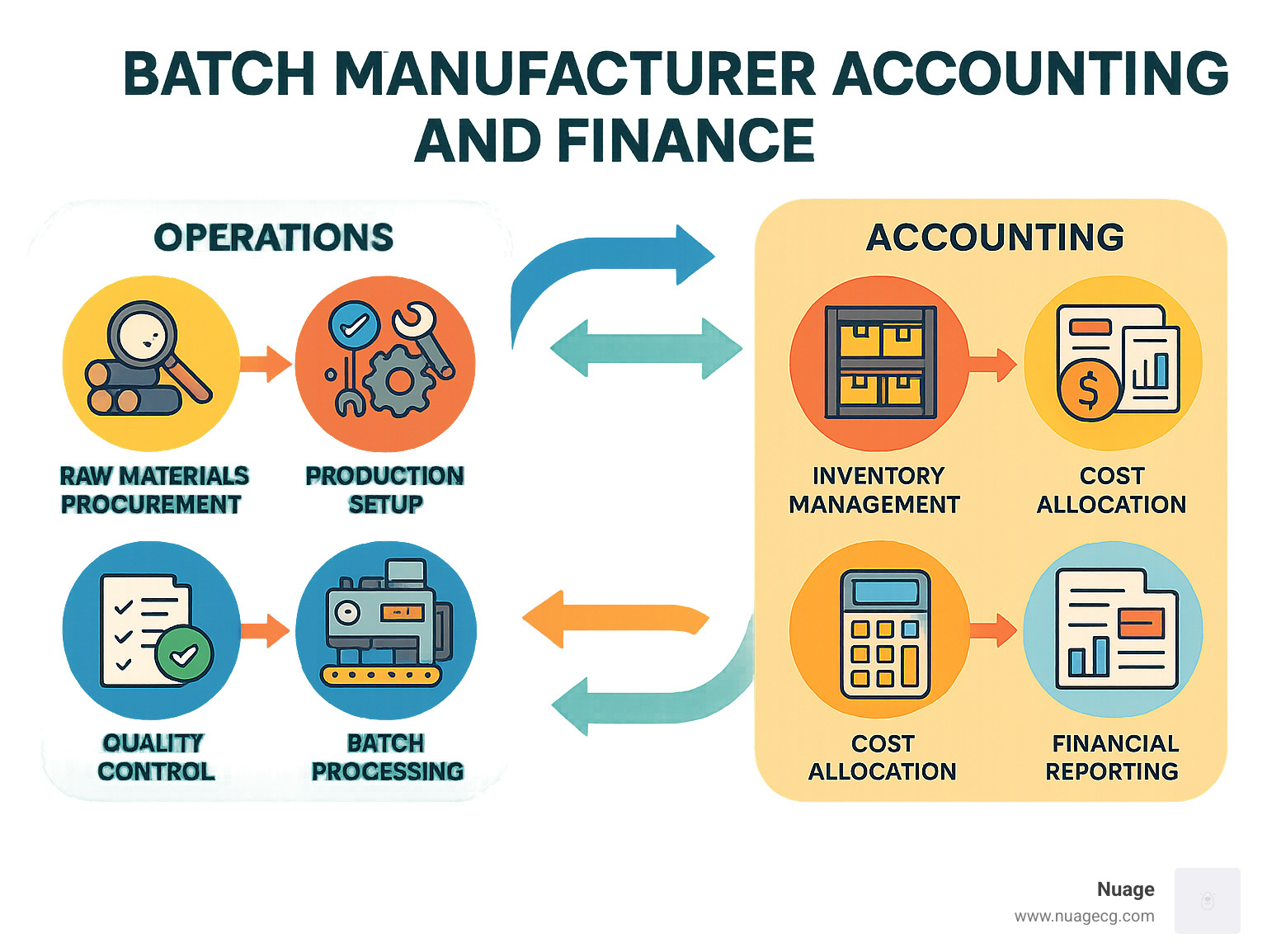
Batch Manufacturer Accounting and Finance terms made easy:
– ERP software for batch manufacturing
– ERP software for food industry
– digital change for manufacturers
Batch Manufacturing 101: Cycles, Set-Ups & How It Differs From Continuous Flow
Ever watched cookies come out of an industrial bakery? That’s batch manufacturing in action—groups of identical products moving through production stages together before the next batch begins. Unlike continuous flow manufacturing (think paper mills or oil refineries running 24/7), batch production works in distinct cycles with clear start and finish points.
“In the vast landscape of manufacturing processes, each with its own merits and drawbacks, batch production stands out as a popular and time-tested method,” notes industry expert Eric Kimberling.
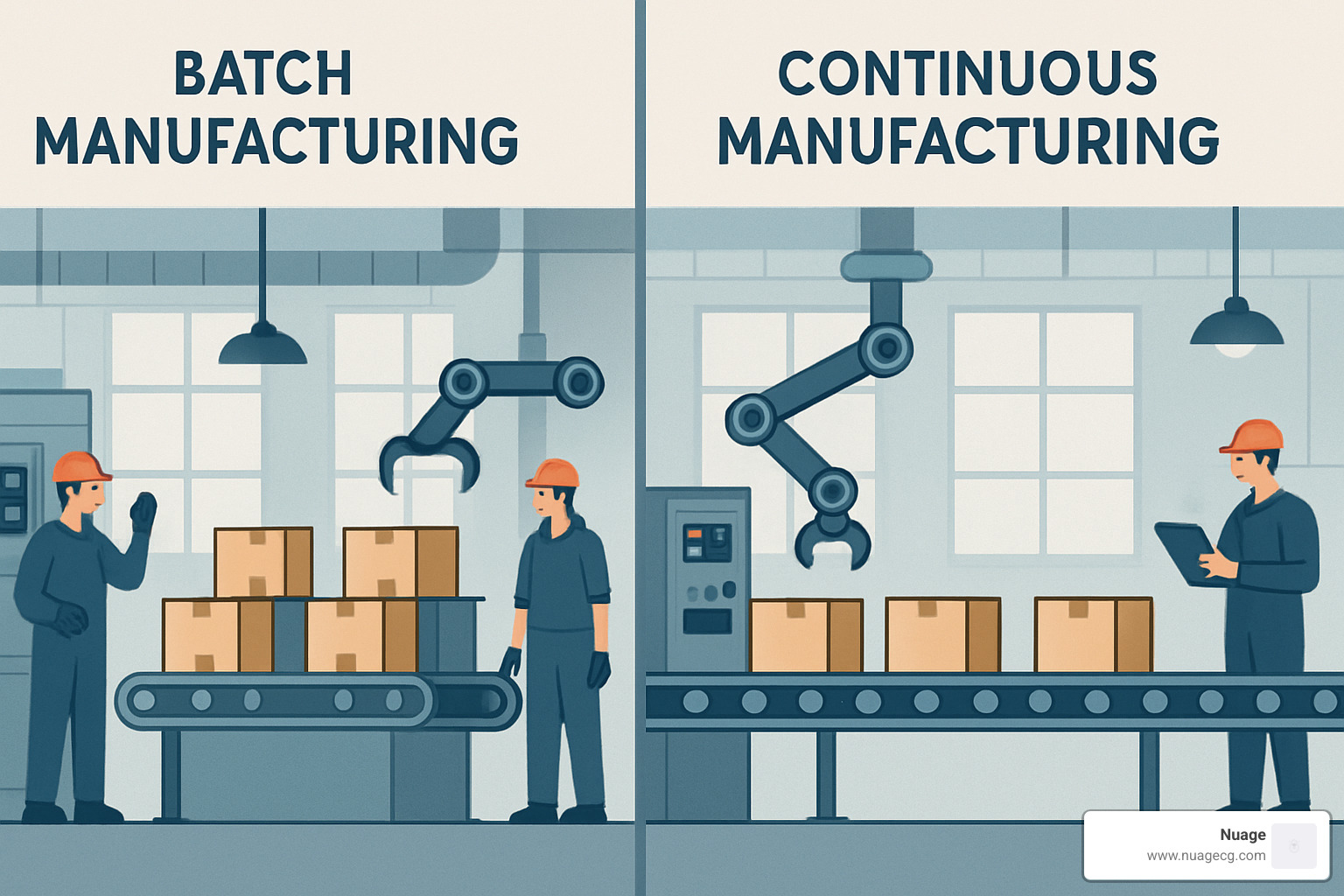
Think of a craft brewery making a batch of summer ale before switching to autumn porter. Each batch follows the same journey—brewing, fermenting, filtering, and packaging—as a group. When one batch finishes, equipment gets cleaned and reconfigured for the next recipe.
What makes batch manufacturing special? First, there’s the flexibility to make different products on the same equipment. Your food company might produce strawberry jam on Monday and orange marmalade on Tuesday using identical kettles and filling lines.
Then there’s the setup and changeover periods—the time between batches when you’re cleaning equipment, adjusting settings, and preparing for the next run. These aren’t producing anything, but they’re essential and costly.
Work-in-progress queues are another hallmark of batch production. You’ll often see batches waiting for their turn at the next production stage, like freshly molded plastic parts cooling before moving to assembly.
Many manufacturers choose batch production for its economies of scale. By spreading fixed setup costs across all units in a batch, each individual product bears less overhead. Make 1,000 units instead of 100, and your per-unit setup cost drops dramatically.
Key Financial Implications of Batch Cycles
The batch approach creates unique financial challenges that your accounting team needs to address:
Setup costs hit your bottom line with every product change. When your cosmetics line switches from day cream to night cream, you’ll incur significant expenses in equipment cleaning, reconfiguration, testing, and documentation. How you allocate these costs makes a huge difference in understanding true product profitability.
Idle time accounting becomes crucial during changeovers. When machines and workers aren’t actively producing, should those costs go to overhead or to specific batches? Your decision affects everything from pricing to performance metrics.
Quality testing typically happens at multiple points throughout batch production. These tests protect your customers but add costs that must be properly assigned to maintain accurate batch profitability.
Lot traceability isn’t just good practice—it’s often legally required. Each batch needs a unique identifier that follows it through production, inventory, and distribution. This traceability system is essential for quality control and potential recalls, but it adds another layer of accounting complexity.
As one pharmaceutical manufacturer finded, “The inefficiencies associated with batch processing cost our industry approximately $50 billion annually.” This staggering figure shows why proper Batch Manufacturer Accounting and Finance practices aren’t just about compliance—they directly impact your profitability.
With the right ERP system for batch manufacturing, these financial challenges become opportunities for better decision-making and improved margins. Modern solutions like and NetSuite are designed to handle the unique demands of batch production environments, turning financial complexity into business clarity.
Batch Manufacturer Accounting and Finance: Core Challenges & Solutions
Batch Manufacturer Accounting and Finance isn’t just about crunching numbers—it’s about connecting the dots between what happens on your production floor and what shows up in your financial statements. Unlike other manufacturing models, batch production creates unique financial problems that require specialized approaches.

When you’re producing in batches, every production run tells its own financial story. The challenge? Making sure that story gets accurately translated into your accounting system. At Nuage, we’ve helped dozens of manufacturers tackle these core challenges:
| Challenge | Description | Solution |
|---|---|---|
| Overhead Allocation | Determining how to distribute fixed costs across batches of varying sizes | Activity-based costing with batch-level cost drivers |
| WIP Valuation | Accurately valuing partially completed batches | Percentage-of-completion method with real-time data capture |
| Regulatory Compliance | Meeting industry-specific requirements (FDA, etc.) | Integrated lot tracking and electronic batch records |
| Multi-Currency Operations | Managing global supply chains and sales | Automated exchange rate adjustments and consolidated reporting |
Batch Manufacturer Accounting and Finance Pain Points
Have you ever felt like your production team and finance department are speaking completely different languages? You’re not alone. In our 20+ years helping manufacturers, we’ve seen these pain points come up again and again:
- Unit-level activities that scale proportionally with batch size
One food manufacturer we partnered with was consistently underpricing their small-batch custom orders because their simplistic allocation method masked the true setup costs. After implementing ABC, they finded these small batches were actually losing money. Their revised pricing strategy not only stopped the bleeding but turned these specialty orders into a profitable segment.
Which inventory valuation method minimizes tax liability?
The short answer: it depends on price trends in your industry and your specific business circumstances.
During inflationary periods (when costs are rising), LIFO typically results in higher COGS and lower taxable income, potentially reducing your tax bill. When prices are falling, FIFO might give you the tax advantage. With stable prices, your method choice has minimal tax impact.
That said, choosing an inventory method solely for tax reasons is like buying a house just for the tax deduction – there are much bigger considerations at play. Your inventory method affects operational clarity, financial reporting, and administrative workload, often in more significant ways than the tax impact.
It’s also worth noting that while LIFO may offer tax advantages in the US, it’s not allowed under International Financial Reporting Standards (IFRS). If you have global operations or might someday, this could complicate your reporting.
Before making any changes to your inventory methods, sit down with a qualified tax professional. Switching methods requires IRS approval, and there may be transition impacts to consider.
Can I stay on cash-basis accounting under the $29M TCJA threshold?
Yes, technically you can – the Tax Cuts and Jobs Act of 2017 allows businesses with average annual revenue under $29 million (over the prior three years) to use cash-basis accounting for tax purposes. This might seem like a welcome simplification for smaller batch manufacturers.
However, there’s a big difference between what’s permitted for tax reporting and what actually helps you run a better manufacturing business. Cash-basis accounting simply doesn’t provide the insights batch manufacturers need because it fails to properly match revenues with production costs.
With cash accounting, you’d struggle to:
– Calculate accurate product profitability
– Properly value your inventory
– Analyze how specific batches performed
– Make informed pricing decisions based on true costs
Most successful batch manufacturers we work with use accrual accounting for management purposes, even if they opt for cash-basis for tax filing. Modern ERP systems like NetSuite and can support both methods simultaneously, giving you the best of both worlds – simplified tax compliance and robust management information.
At Nuage, we’ve seen manufacturers try to operate with cash-basis accounting alone, and they inevitably hit a wall when trying to make strategic decisions about pricing, product mix, or production planning. The right accounting approach is fundamental to manufacturing success.
Conclusion
Changing Batch Manufacturer Accounting and Finance from chaos to harmony isn’t just about new software—it’s about creating a seamless connection between your operations and finance teams that gives everyone a clear, unified view of your business.
Here at Nuage, we’ve spent more than two decades walking alongside manufacturers through their digital change journeys. Time and again, we’ve witnessed how bringing operational and financial data together through platforms like NetSuite and can completely revolutionize how batch manufacturing businesses operate.
The rewards go far beyond just making your accounting department more efficient:
When you have accurate cost data at your fingertips, you can make truly informed strategic decisions about your product mix, pricing strategies, and whether to make components in-house or buy them. Your variance analysis will spotlight opportunities to optimize processes that you might never have noticed before. Your integrated systems ensure you stay compliant with traceability requirements and documentation standards. Perhaps most importantly, precise costing leads directly to improved margins and healthier cash flow.
As one manufacturing CFO we work with put it: “This isn’t a one-time project—it’s an ongoing evolution. Each improvement reveals new opportunities.” That’s the beauty of this journey—it continues to deliver value long after implementation.
We’ve found that manufacturers who accept this integrated approach gain a competitive edge that’s difficult for others to match. They respond faster to market changes, make better pricing decisions, and identify inefficiencies before they become problems.
We’d love to connect with you to discuss your specific challenges and explore how we can help bring your batch manufacturing operations and finance into perfect harmony. With offices in Manhattan Beach, CA and Ponte Vedra, FL, our team of experts is ready to support your change journey, no matter where you’re located.
For more information about how NetSuite can support your batch manufacturing operations, visit our NetSuite solutions page. Together, we can turn your accounting and finance challenges into your competitive advantage.