

Moving Beyond Stock Counts to Strategic Advantage

Supply chain inventory optimization management is the strategic process of balancing inventory levels across your entire supply chain network to minimize costs while maximizing customer service and profitability. It moves beyond simply tracking stock counts to use data, advanced forecasting, and technology to determine exactly how much inventory to hold, where to hold it, and when to replenish it.
Quick Answer: What is Supply Chain Inventory Optimization Management?
- Purpose: Balance supply with demand to reduce costs and improve service levels
- Key Components: Demand forecasting, safety stock calculation, reorder point optimization, and multi-location inventory planning
- Primary Goal: Have the right inventory, in the right place, at the right time
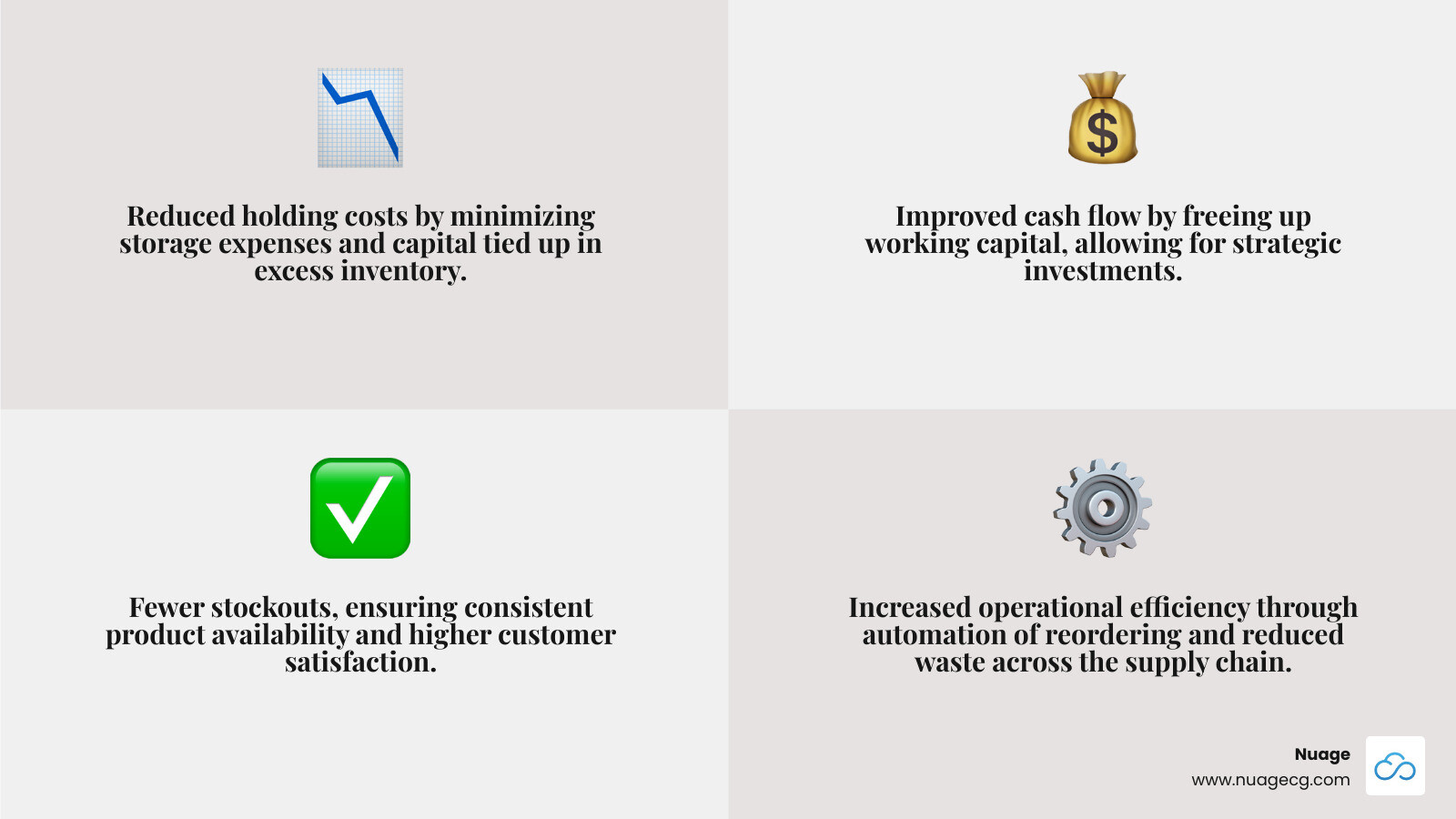
- Main Benefits: Reduced holding costs, improved cash flow, fewer stockouts, improved customer satisfaction
- Core Difference from Basic Management: Uses predictive analytics and optimization algorithms rather than reactive ordering
The stakes have never been higher. Research firm IHL estimates that the cost of overstocks and stockouts worldwide neared $1.8 trillion in 2023. That’s not a rounding error—it’s a massive drain on global business profitability. Yet many companies still approach inventory as a reactive necessity rather than a strategic advantage.
The traditional approach of simply keeping shelves stocked and counting boxes is no longer enough. Today’s environment demands precision. The Amazon Effect has made same-day or next-day delivery an expectation, not a luxury. Brand loyalty is eroding as customers have endless choices at their fingertips. And supply chains face constant disruption from global events, weather, and shifting consumer behavior.
Inventory optimization transforms this challenge into opportunity. It’s not about having more inventory—it’s about having the right inventory. By analyzing historical sales data and market trends, companies can predict demand more accurately and reduce the costs associated with overstocking or stockouts. This frees up cash flow and allows resources to be allocated more effectively.
The difference between basic inventory management and true optimization is like the difference between a thermostat and a smart home system. Management tracks what you have and alerts you when it’s low. Optimization predicts what you’ll need, when you’ll need it, and automatically adjusts based on dozens of variables you might never consider manually.
More than half (52%) of companies currently host critical enterprise applications in the Cloud, while 76% believe artificial intelligence (AI) will be an important part of their supply chain within the next three years. These aren’t just trends—they’re indicators that the future of inventory management is here.
Modern NetSuite ERP platforms integrate company-wide data across finance, sales, and manufacturing into a single database, providing the foundation for sophisticated optimization. When combined with demand intelligence from platforms like Salesforce, businesses gain unprecedented visibility into what customers actually want, not just what they bought last year.
I’m Louis Balla, and I’ve spent over 15 years helping companies transform their supply chain inventory optimization management strategies through digital change and NetSuite implementation. At Nuage, I’ve seen how businesses using only 20% of their ERP’s potential can open up dramatic improvements in working capital, service levels, and profitability when they bridge the gap between basic use and strategic optimization.
The Core Components of a Modern Inventory Strategy
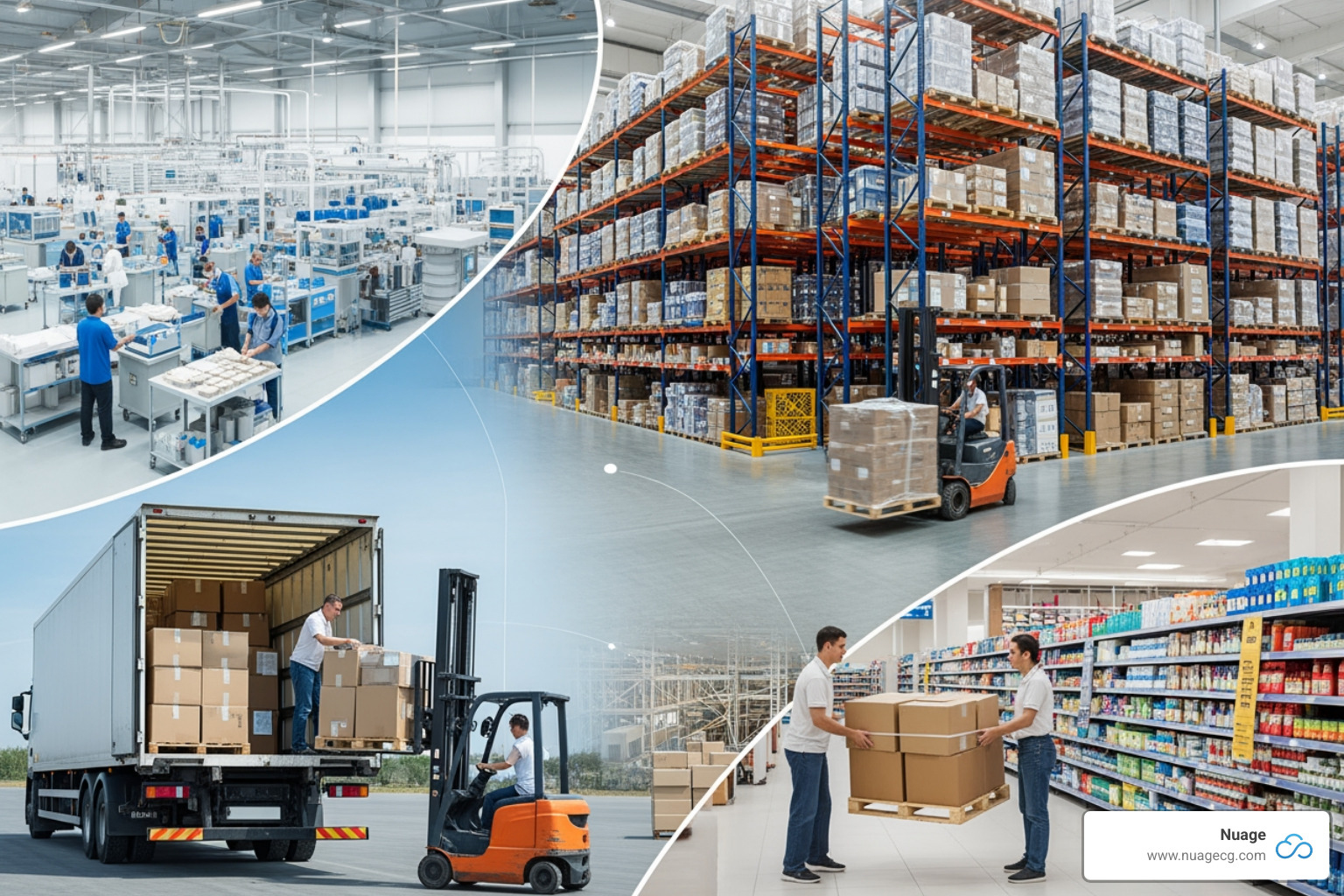
This section explains the foundational pillars required to build an effective optimization strategy.
What is Supply Chain Inventory Optimization and Why is it Crucial?
Supply chain inventory optimization management is about precisely balancing the amount of stock on hand with demand to minimize costs while ensuring product availability. It’s crucial because it moves beyond reactive stock management to a proactive strategy that improves efficiency and profitability.
In today’s market, with increased e-commerce and an unprecedented level of competition, businesses face immense pressure. Customers expect rapid delivery, and their brand loyalty is eroding in the face of abundant choices. This environment makes inventory optimization not just beneficial but essential for survival. By optimizing, we aim to:
- Balance supply and demand: Ensuring we have enough product to meet customer needs without overstocking.
- Minimize costs: Reducing expenses associated with holding, obsolescence, and stockouts.
- Maximize service levels: Meeting customer expectations for product availability and delivery times.
- Reduce waste and obsolescence: Preventing products from becoming outdated or unsellable before they leave the warehouse.
As Nuage, we understand that this strategic approach is what separates thriving businesses from those struggling with the $1.8 trillion burden of overstocks and stockouts.
Key Elements of Inventory Optimization
Effective supply chain inventory optimization management relies on several interconnected elements, each playing a vital role in achieving that perfect balance:
- Demand Forecasting: This is the heartbeat of inventory optimization. Accurate forecasting predicts customer demand using historical sales data, market trends, promotional activities, and even external factors like weather. It’s not just about what sold yesterday, but what will sell tomorrow.
- Inventory Strategy: This involves defining how we categorize and manage different types of inventory. For instance, using ABC analysis to prioritize high-value items for closer monitoring.
- Stock Replenishment: Determining when and how much to reorder. This considers supplier lead times, production cycles, and delivery reliability to ensure timely stock arrival.
- Lead Time Management: Understanding and reducing the time it takes from placing an order to receiving inventory. Shorter, more reliable lead times reduce the need for large safety stocks.
We also consider the four main types of inventory, and how optimization applies to each:
- Raw Materials (RM): The basic components used in production. Optimization here focuses on aligning procurement with production schedules and supplier lead times, avoiding excessive capital tied up in unused materials.
- Work-in-Progress (WIP): Partially finished goods undergoing change. Optimizing WIP means streamlining production processes to reduce bottlenecks and minimize the time products spend in this stage, improving throughput.
- Finished Goods (FG): Products ready for sale. This is where demand forecasting and customer service levels are paramount, ensuring products are available when and where customers want them.
- Maintenance, Repair, and Operations (MRO): Items like spare parts, lubricants, and office supplies. Optimization ensures these essential items are available to maintain operations without excessive holding costs.
The Goals and Benefits of an Optimized Inventory
The overarching goal of supply chain inventory optimization management is to transform inventory from a cost center into a strategic asset. The benefits are far-reaching and directly impact our bottom line and customer relationships:
- Reduced Holding Costs: Less excess inventory means lower costs for storage, insurance, security, and reduced risk of obsolescence or damage. This directly improves profitability.
- Improved Cash Flow: Capital tied up in excess inventory is money that can’t be invested elsewhere. Optimization frees up this working capital, allowing for more strategic investments or debt reduction.
- Improved Customer Satisfaction: By minimizing stockouts and ensuring product availability, we meet customer expectations more consistently, leading to happier customers and repeat business.
- Increased Productivity: Streamlined inventory processes reduce manual efforts, improve warehouse efficiency, and allow employees to focus on more value-added tasks.
- Minimized Risk of Overstock or Stockouts: We avoid the dual nightmares of having too much (leading to markdowns and waste) or too little (leading to lost sales and frustrated customers).
- Numerous benefits for business operations, extending from streamlined operations to improved customer satisfaction and sustainable growth.
Optimized inventory management allows us to operate more leanly, respond more quickly to market changes, and deliver a superior customer experience—all while boosting our profitability.
Proven Techniques for Supply Chain Inventory Optimization Management
This section details the most effective, actionable techniques businesses can implement to gain control over their inventory and costs.
Foundational Analysis and Prioritization
To effectively optimize inventory, we must first understand what we have and what truly matters.
- ABC Analysis: This technique categorizes inventory items into three groups based on their annual consumption value:
- A-items: High-value, low-volume items that require close monitoring and tight control. These are our most critical products.
- B-items: Medium-value, medium-volume items that need moderate control.
- C-items: Low-value, high-volume items that can be managed with simpler controls.
This helps us focus our optimization efforts where they will have the greatest impact.
- SKU Rationalization: We regularly review our Stock Keeping Units (SKUs) to identify and eliminate underperforming, redundant, or obsolete products. This reduces complexity, frees up capital, and prevents deadstock from accumulating.
- Demand Planning: Beyond simple forecasting, demand planning involves a collaborative process across sales, marketing, and operations to create a consensus forecast. This holistic view improves accuracy and aligns various departments.
- Setting a Quarterly Inventory Budget: Establishing clear financial targets for inventory levels each quarter helps us set realistic goals and KPIs, ensuring inventory management aligns with overall financial objectives.
- Product Lifecycle Management: Different stages of a product’s life (introduction, growth, maturity, decline) require different inventory strategies. Optimizing inventory means adjusting stock levels and reordering policies as products move through these phases.
Core Replenishment and Ordering Models
Once we understand our inventory, we implement models to manage its flow efficiently.
| Technique | Best For | Key Benefit | Primary Challenge |
|---|---|---|---|
| ABC Analysis | Prioritizing diverse inventory | Focuses resources on high-value items | Requires consistent data and regular review |
| Economic Order Quantity (EOQ) | Stable demand, known costs | Minimizes total ordering and holding costs | Assumes constant demand and costs; less flexible |
| Just-in-Time (JIT) | Predictable demand, reliable suppliers | Reduces holding costs, minimizes waste | Highly dependent on supplier reliability; vulnerable to disruptions |
| Vendor-Managed Inventory (VMI) | Strong supplier relationships, stable demand | Shifts inventory responsibility, reduces stockouts | Requires high trust and data sharing with suppliers |
- Safety Stock Calculation: This is our buffer against unexpected demand spikes or supply delays. Calculating the optimal safety stock level involves considering demand variability, lead time variability, and desired service levels. It’s about finding the sweet spot where we’re protected without excessive holding costs.
- Reorder Point (ROP) Formula: The ROP is the inventory level at which a new order should be placed. It’s typically calculated as (average daily usage x lead time in days) + safety stock. This ensures we reorder in time to avoid stockouts.
- Just-in-Time (JIT) Principles: This strategy aims to minimize inventory and receive materials or produce goods only as they are needed. While it significantly reduces holding costs and waste, it demands highly reliable suppliers and accurate demand forecasting.
Collaborative and Advanced Strategies
Beyond the basics, these strategies leverage collaboration and advanced analytics for deeper optimization.
- Vendor-Managed Inventory (VMI): In VMI, the supplier takes responsibility for managing the inventory levels of their products at our location. They monitor our stock, forecast demand, and replenish as needed. This can lead to more accurate inventory decisions as suppliers often have better forecasting capabilities and a broader market view.
- Multi-Echelon Inventory Optimization (MEIO): For complex supply chains with multiple warehouses, distribution centers, and retail locations, MEIO provides a holistic approach. It optimizes inventory levels across the entire network simultaneously, considering interdependencies between different stages and locations. This prevents over-buffering in one part of the chain while another faces shortages.
- Building Strong Supplier Relationships: As Nuage, we emphasize that strong, collaborative relationships with suppliers are foundational to effective inventory optimization. This involves transparent communication, data sharing, joint planning, and mutual trust. Reliable suppliers are key to successful JIT and VMI implementations, reducing lead times and improving supply chain resilience.
- Continuous Improvement Cycles: Inventory optimization is not a one-time fix. It requires continuous monitoring, analysis, and adjustment. Implementing lean principles and a culture of continuous improvement ensures that our strategies evolve with market changes and internal processes are constantly refined.
From Reactive to Predictive: The Technology Driving Modern Inventory Strategy
Technology is the engine that powers modern inventory optimization, turning data into actionable intelligence.
The Role of Data in Effective Supply Chain Inventory Optimization Management
At its heart, effective supply chain inventory optimization management is data-driven. Without accurate, timely data, we’re flying blind.
- Data Analytics for Decision-Making: We use sophisticated analytics to process vast amounts of data, identifying patterns, trends, and anomalies that inform our inventory decisions. This allows us to move from gut-feel decisions to informed, strategic choices.
- Historical Sales Data Analysis: This is the baseline for forecasting. By understanding past sales performance, we can project future demand. However, it’s just one piece of the puzzle.
- Real-time Data Integration: Integrating data from various sources—sales, production, shipping, customer feedback—in real-time provides an up-to-the-minute picture of our inventory and demand landscape.
- The Importance of a Single Source of Truth: When all departments access the same, consistent data, it eliminates discrepancies and ensures everyone is working from the same playbook. This is a core strength of integrated ERP systems.
- Predictive Analytics for Forecasting: Moving beyond historical data, predictive analytics uses statistical algorithms and machine learning to forecast future demand with greater accuracy, considering a wider range of influencing factors.
Essential Software and Platforms
Technology provides the tools to manage and optimize our inventory with precision.
- Enterprise Resource Planning (ERP) systems: ERP systems like NetSuite ERP are the backbone of modern inventory optimization. They integrate all core business processes—from finance and HR to manufacturing and supply chain—into a single, unified system. This integration eliminates data silos and provides a comprehensive view of inventory across the entire organization.
- The Power of an Integrated Platform: As a NetSuite Optimization Engine, we at Nuage have seen how a truly integrated platform provides real-time visibility, automates routine tasks, and offers powerful analytics that standalone systems simply can’t match. It’s about having one system that talks to everything else.
- Inventory Management Software: These specialized tools help track inventory levels, manage warehouse locations, process orders, and handle returns. They are often modules within a larger ERP system or can be integrated with them.
- How CRM Data from Platforms like Salesforce Informs Demand: Customer Relationship Management (CRM) systems capture invaluable customer data, including preferences, purchase history, and feedback. Integrating this with our inventory system helps us understand actual customer demand, not just sales numbers, leading to more accurate forecasting.
- Warehouse Management Systems (WMS): WMS solutions optimize warehouse operations, from receiving and putaway to picking, packing, and shipping. They ensure efficient movement and storage of goods, which directly impacts inventory accuracy and speed.
The Future is Now: AI and Automation
Artificial intelligence and automation are revolutionizing supply chain inventory optimization management, making it smarter and more efficient.
- Artificial Intelligence (AI) for Demand Sensing: AI algorithms can analyze vast datasets, including unstructured data like social media trends and news, to detect subtle shifts in demand patterns that human analysts might miss. This allows for incredibly precise and adaptive forecasting.
- Machine Learning (ML) for Pattern Recognition: ML models learn from historical data to identify complex relationships and predict future outcomes. For inventory, this means better predictions of sales, lead times, and even potential disruptions.
- Loftware’s survey on AI adoption highlights this shift: 76% of companies believe AI will be an important part of their supply chain within the next three years. This isn’t just hype; it’s a recognition of AI’s transformative power.
- Internet of Things (IoT) for Real-time Tracking: IoT devices, such as RFID tags and smart sensors, provide real-time visibility into inventory location, quantity, and even environmental conditions (e.g., temperature for perishable goods). This level of transparency is crucial for dynamic optimization.
- Automation for Reducing Manual Errors: Automating tasks like reordering, stock transfers, and data entry reduces human error, speeds up processes, and ensures consistency. This frees up our team to focus on strategic analysis rather than repetitive tasks.
Measuring Success and Building a Resilient Supply Chain
Optimization is not a one-time project but a continuous process of measurement and improvement that strengthens the entire business.
Key Performance Indicators (KPIs) for Supply Chain Inventory Optimization Management
To know if our optimization efforts are working, we need to measure them. Here are the crucial KPIs we track:
- Inventory Turnover Ratio: This measures how many times inventory is sold or used over a specific period. A higher ratio generally indicates efficient inventory management.
- Days of Inventory on Hand (DOH): This tells us how many days it would take to sell our current inventory. Lower DOH means less capital tied up in stock.
- Carrying Cost of Inventory: This includes all costs associated with holding inventory, such as storage, insurance, obsolescence, and capital costs. Minimizing this is a direct goal of optimization.
- Stockout Rate: The percentage of times we’re unable to meet customer demand due to insufficient stock. A low stockout rate indicates good customer service.
- Fill Rate: The percentage of customer orders that can be fulfilled immediately from existing stock. A high fill rate signifies excellent service.
- Forecast Accuracy: How closely our demand forecasts match actual sales. High accuracy is fundamental to effective optimization.
Building Supply Chain Resilience and Sustainability
Supply chain inventory optimization management plays a pivotal role in building a robust and adaptable supply chain capable of withstanding disruptions and operating responsibly.
- How Optimization Reduces Vulnerability to Disruptions: By accurately forecasting demand and managing safety stock strategically, we create buffers against unexpected events like supplier delays or sudden demand surges. This allows us to absorb shocks without significant impact on customer service.
- Creating Agility to Respond to Market Shifts: An optimized inventory system is inherently agile. It allows us to quickly adapt to changes in consumer preferences, new product introductions, or shifts in the competitive landscape, minimizing the risk of obsolescence.
- Reducing Waste and Energy Consumption for a Greener Supply Chain: Less excess inventory means less waste from obsolete products, fewer resources consumed in storage, and optimized transportation, all contributing to a more sustainable and environmentally friendly supply chain.
- The Role of Safety Stock in Resilience: While the goal is lean inventory, a strategically calculated safety stock is crucial for resilience. It’s the calculated insurance policy that allows us to maintain operations and customer satisfaction when the unexpected happens.
Common Challenges and How to Overcome Them
Even with the best intentions, implementing supply chain inventory optimization management can be challenging.
- Fluctuating Market Demands: Consumer behavior is notoriously unpredictable.
- Overcome: Leverage AI-driven predictive analytics that incorporate a wide range of data points, not just historical sales, to better anticipate shifts. Implement flexible supply chain strategies.
- Supply Chain Disruptions: Geopolitical events, natural disasters, and global pandemics can wreak havoc on supply.
- Overcome: Diversify supplier bases, establish strong supplier relationships for transparent communication, and build strategic safety stock for critical items.
- Lack of Automation: Manual processes are slow, error-prone, and can’t keep up with modern supply chain complexity.
- Overcome: Invest in integrated ERP systems and inventory management software that automate routine tasks and provide real-time data.
- Data Silos: Information trapped in different departments or legacy systems prevents a unified view of inventory.
- Overcome: Implement a single source of truth, typically an ERP system, that integrates data across all business functions. This is where a robust NetSuite optimization strategy becomes invaluable, ensuring all your data works together seamlessly.
Frequently Asked Questions about Inventory Optimization
What is the difference between inventory management and inventory optimization?
Inventory management is the broad process of ordering, storing, and using inventory. It focuses on the day-to-day operations of ensuring products are available and accounted for. Inventory optimization, on the other hand, is a strategic subset of management that uses advanced analytics and forecasting to determine the optimal quantity and placement of stock to maximize profitability and efficiency. It answers not just “what do we have?” but “what should we have, and where, to achieve our business goals?”
What are the first steps to optimizing inventory?
The journey to optimization begins with understanding. We recommend starting by centralizing your data to get a clear, unified picture of your current inventory state. Then, perform an ABC analysis to prioritize your products based on their value and importance. Finally, critically review your demand forecasting methods to ensure they are as accurate and data-driven as possible. These foundational steps provide the clarity needed for more advanced optimization.
How often should I review my inventory strategy?
Your overall inventory strategy should be reviewed at least quarterly to account for seasonal changes, market shifts, and new business goals. However, for critical elements like demand forecasts and safety stock levels for high-value items, continuous monitoring is ideal, especially in volatile markets. Technology, particularly integrated ERP systems, can automate much of this continuous monitoring, alerting us to deviations that require immediate attention.
Conclusion: Turn Your Inventory into a Competitive Edge
We’ve explored how supply chain inventory optimization management is far more than just counting boxes; it’s a strategic imperative that drives profitability, improves customer loyalty, and builds resilience in an ever-changing market. From leveraging advanced analytics and AI to implementing proven techniques like ABC analysis and MEIO, the path to optimized inventory is clear.
By focusing on precise demand forecasting, strategic replenishment, and the power of integrated technology, we can transform inventory from a potential liability into a significant competitive advantage. This means reduced holding costs, improved cash flow, fewer stockouts, and a consistently satisfied customer base.
As a NetSuite Optimization Engine, we at Nuage are dedicated to helping businesses like yours implement and fine-tune the systems needed to achieve strategic inventory control. We understand the nuances of integrating powerful platforms to open up their full potential. Open up your supply chain’s full potential by focusing on NetSuite solutions.